
Dawn of War 4 RTS: Five Tiers of Evidence, 35 Days Out
Warhammer 40,000: Dawn of War IV arrives on December 3, with Commander Edition owners getting in on November 30. That is five weeks from today, and the information situation around it is stranger than usual. Press have played two complete campaigns. A closed beta ran last week under terms that banned video, screenshots and streaming but explicitly permitted testers to write about it, including on their own social accounts. A nine-minute overview trailer went up on October 21. And a Year One roadmap exists that has no dates attached to any of it.
So what we know about this game is layered by how directly anyone actually saw it. A campaign a reviewer played for hours is a different kind of fact from a mode named in a press release, and treating them as equivalent is how pre-launch coverage goes wrong.
This sorts everything into five tiers, strongest evidence first.
| Tier | How It Is Known | What Sits Here |
|---|---|---|
| 1 | Played at length by press | Two full faction campaigns, two prologues, 1v1 Skirmish |
| 2 | Played by beta testers, no footage permitted | Skirmish against AI, scheduled 1v1 multiplayer |
| 3 | Shown on screen in the overview trailer | All four factions, base building, Last Stand, the Army Painter |
| 4 | Stated by the developer, not yet demonstrated publicly | Stratagems, cover, Sync Kills, 30 maps, 2v2 and 3v3, co-op campaign |
| 5 | Promised for after launch, no dates | Crusade Mode, Mission Editor, two story expansions, a fifth faction |
Nothing below tier three should be treated as a thing you have seen working.
Tier One: What Press Have Actually Played
This is the firmest ground, and it covers more than preview builds usually do.
The press build contained the Astra Militarum and Space Marines prologues, the complete Ork and Adeptus Mechanicus campaigns – over 30 missions between them – and 1v1 Skirmish. Two entire faction campaigns is an unusually generous preview, and it is the reason the impressions coming out of it are more confident than typical pre-release chatter.
Those impressions have been strong. Polygon’s preview said the game “has the potential to be the best Warhammer 40,000 game ever.” PC Gamer’s headline was that two of the campaigns are “everything I hoped they’d be.” Both are quoted in the studio’s own roundup, which is worth noting as context without discounting them – the quotes are real, the selection is not neutral.
Equally worth noting is what the preview build did not include. Larger multiplayer matches and Last Stand were absent. So the modes most likely to determine this game’s long-term life are the ones nobody outside the studio has properly tested.
That asymmetry matters for a series with this history. Dawn of War’s reputation was built on campaigns, but its longevity came from multiplayer and from Last Stand specifically. A game that previews beautifully in single-player and stumbles in 3v3 is a very plausible outcome that the current evidence cannot rule out.
Tier Two: The Dawn of War 4 RTS Beta Nobody Could Film
The closed beta ran October 21 to 26, finishing three days ago, and its terms produced an unusual evidentiary situation.
What was playable:
- 1v1 Skirmish against AI, available throughout the test.
- 1v1 multiplayer, during scheduled sessions whose times went only to selected participants.
What testers could and could not do:
- No recording, livestreaming, screenshots or sharing of gameplay footage. That was explicit.
- Written discussion of the experience was permitted, including on participants’ own social media.
- There was no private beta Discord. Testers were pointed toward public community channels instead.
Read those three together and the design intent is clear. The studio wanted feedback in public and in words, with no footage escaping. Which means the community conversation about Dawn of War IV right now consists entirely of written testimony with nothing to check it against.
That is a genuinely interesting position for a researcher. Text-only beta discourse is harder to verify than a clip, easier to exaggerate in either direction, and impossible to fact-check by watching. So any specific performance claim, balance complaint or bug report circulating from last week’s beta sits in tier two: real people played it, and nobody can show you.
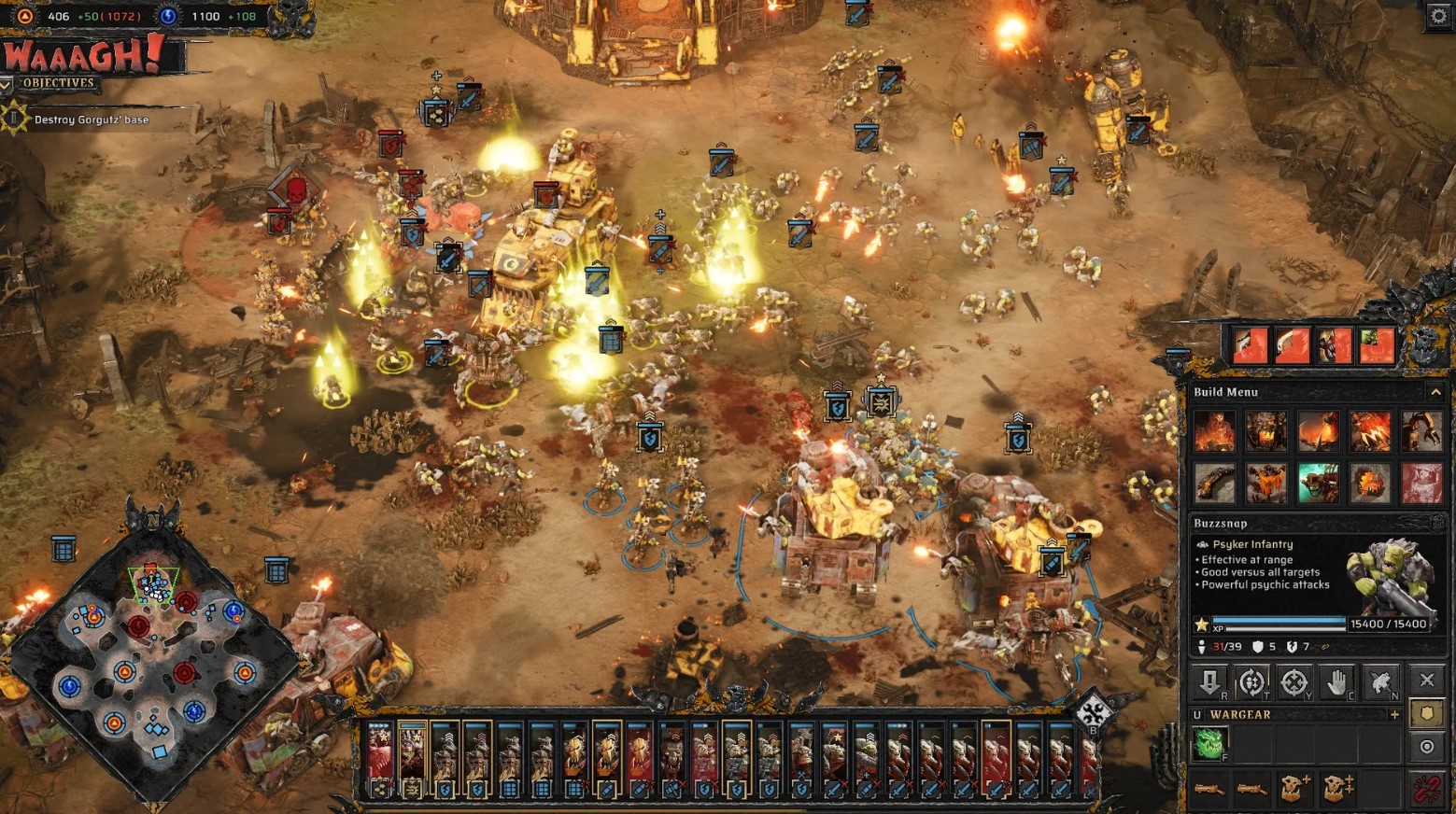
The practical reading: treat beta impressions as genuine signal about mood and poor evidence about specifics. Someone saying the Orks felt sluggish is worth knowing. Someone quoting exact unit numbers from a build that changed five days ago is not.
Tier Three: What the Trailer Shows
A nearly nine-minute overview trailer landed on October 21, the same day the beta opened, and it is the most substantial thing anybody outside the test has actually watched.
On screen: all four playable factions, the story campaigns, base building, Skirmish, Multiplayer, Last Stand, and the Army Painter. A Necron Chronomancer appears, though whether as a playable unit was not stated.
The base-building footage is the headline, because it is the series arguing with its own past. Dawn of War’s first game was built on base construction and large-scale battles. The second dropped base building almost entirely for squad-level tactics. The third tried to fuse the two and satisfied neither camp. This one has been positioned explicitly as a return to the 2004 approach, with greater emphasis on base building and resource management, and the trailer is where that claim becomes something you can look at rather than read.
The Army Painter has been described as the most comprehensive customisation suite in the franchise’s history, covering armour, equipment, decals and colour schemes, with ready-made schemes included for the most popular chapters. For a Warhammer game, that is not a cosmetic feature. Painting is the hobby.
Tier Four: Stated, Not Yet Demonstrated
Here is everything the developer has described that nobody outside has verified in motion. It is the largest tier, which is normal five weeks out.
Combat systems:
- Requisition points captured and held to fund research, recruitment and deployment.
- A cover system that reduces damage to units positioned behind it, carried over from the second game’s contribution to the series.
- An expanded Sync Kill system, with a combat director that develops it further.
- Stratagems – powerful abilities earned by banking resources, such as a Space Marine orbital bombardment.
Modes and scale:
- Skirmish with four match types: Domination, Annihilation, Maelstrom and Defend.
- Competitive 1v1, 2v2 and 3v3.
- 30 maps at launch.
- Last Stand, returning from Dawn of War II and deliberately designed to be less hero-centric and less MOBA-like than the original version.
- Campaign co-op with a second player.
Campaign structure:
- Set on Kronus, roughly two centuries after Dark Crusade.
- Continuing Cyrus and Jonah’s story as they rebuild their chapter, written by John French.
- A separate campaign for each faction.
- Branching critical decisions, with some missions appearing only on later playthroughs.
That Last Stand description deserves attention, because it is the clearest statement of intent in the whole package. Saying out loud that the returning mode will be less hero-centric and less MOBA-like is a direct acknowledgement of the complaint that followed the series for a decade. Whether the execution matches the diagnosis is a tier-one question nobody can answer yet, since Last Stand was not in the press build.
| Faction | Why It Is In |
|---|---|
| Space Marines | Series staple, here split across two chapters that play differently |
| Orks | Series staple since 2004 |
| Adeptus Mechanicus | Had never appeared in a Dawn of War game before |
| Necrons | Followed up from the tease at the end of Dawn of War III |
The Necrons entry is the quietly reassuring one. Resolving a loose thread left dangling by the previous game’s ending is the behaviour of a team treating the series as continuous rather than starting over.
Tier Five: The Dawn of War 4 RTS Roadmap Is a Promise, Not a Feature
Clearly separated, because roadmaps are the weakest evidence on this page.
Free Year One updates are planned to add:
- Crusade Mode.
- New maps.
- New modes.
- New Commanders.
- The Mission Editor.
Two major paid story expansions are planned, one set on Kronus and one introducing a new playable faction.
No release dates have been announced for any of it.
Every item there is reasonable and none of it is purchasable confidence. A Mission Editor in particular is the single most consequential thing on the list for an RTS – community map-making is what keeps strategy games alive for a decade – and “planned for Year One” is a wide window.
The honest framing for anyone pre-ordering on the strength of that roadmap: you are buying the December 3 build. The rest is a stated intention from a studio that has already moved this game once.
Why KING Art, and Why It Matters
Worth stating plainly, because it is the biggest structural fact about this release and it is easy to miss.
This is the first Dawn of War not made by Relic Entertainment. Development is by KING Art Games, the German studio behind Iron Harvest, with Deep Silver publishing, Jan Theysen as creative director, Elliott Verbiest designing and John French writing. It runs on Unity.
Games Workshop invited KING Art to pitch for a Dawn of War installment during Iron Harvest’s development, and the studio has named the original game’s large-scale battles as a major inspiration. Iron Harvest is relevant experience in the most literal sense – it is a base-building, cover-based, company-of-heroes-shaped RTS, which is very close to the thing this game is trying to be.
It is also fair to say Iron Harvest was well-liked rather than beloved. A studio with one solid RTS to its name taking over a series whose first entry is still cited as a genre high point is a real risk, and the strength of the press campaign impressions is the main evidence against it mattering.
The Delay, Read Honestly
Dawn of War IV was announced at Gamescom in August 2025 for a September 17, 2026 release. On August 12, 2026 it moved to December 3.
The stated reasons were performance optimisation, bug fixing, gameplay polish and acting on community playtest feedback, with Theysen saying the additional time would let the team keep optimising performance, resolving bugs and applying further polish.
Two and a half months is a modest, specific delay – not the kind of slip that signals trouble. And the closed beta that ran last week is reasonable evidence the stated reasons were the actual reasons: a studio buying time for playtest feedback and then running another playtest is behaving consistently.
For context on what you are paying: the standard edition is listed at $59.99, discounted 10% to $53.99 for pre-orders, with the Commander Edition adding three days of early access from November 30.
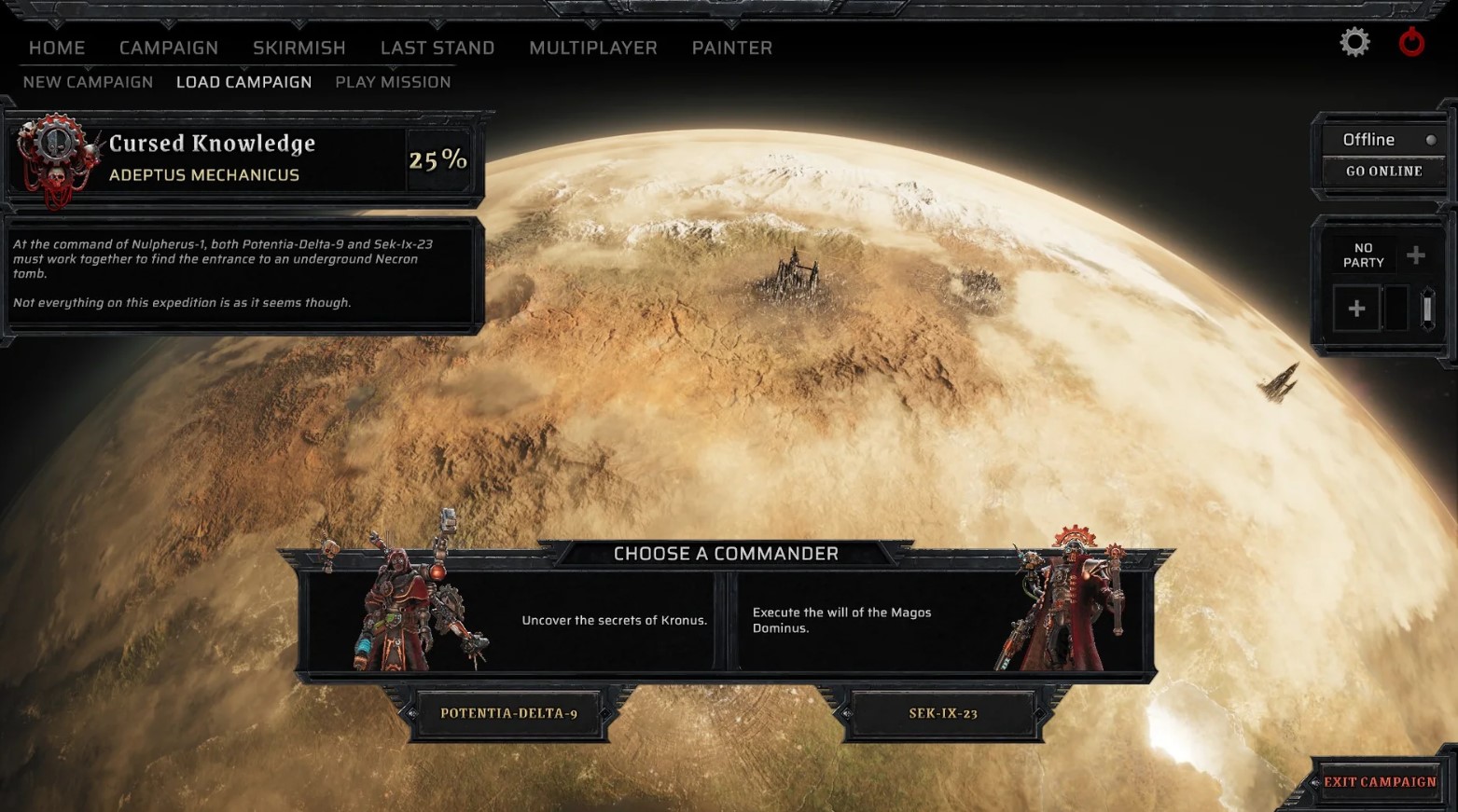
Two Chapters, One Faction
The most recent faction breakdown confirmed that Space Marines are not one playstyle but two, and the split is more meaningful than a colour swap:
- Blood Ravens are the returning series staple, described as more precise and tactical, favouring espionage and careful positioning before committing to an attack.
- Dark Angels are new to Dawn of War, built around direct forceful assaults, shock attacks and sudden strikes with heavily armoured formations.
Both share the same loyalty and the same roster theme, and they play differently. That is a sensible way to give the series’ most popular faction internal variety without adding a fifth army, and it means the Space Marine slot in a 3v3 can mean two quite different things.
FAQ
When does Dawn of War 4 release?
December 3, 2026 on PC, with Commander Edition owners getting access from November 30 through a three-day early start.
Who is developing it?
KING Art Games, the German studio behind Iron Harvest, published by Deep Silver. It is the first Dawn of War not developed by Relic Entertainment.
What factions are playable at launch?
Space Marines, Orks, Necrons and Adeptus Mechanicus. Space Marines are split into the Blood Ravens and the Dark Angels, who play differently.
Does it have base building?
Yes. The game has been positioned as a return to the original’s approach, with greater emphasis on base building and resource management than the second or third entries.
What multiplayer modes are there?
Competitive 1v1, 2v2 and 3v3, Skirmish with four match types, and Last Stand returning from Dawn of War II, designed to be less hero-centric this time. Thirty maps are planned for launch.
Was there a beta?
Yes, a closed beta ran October 21 to 26, 2026, with 1v1 Skirmish against AI plus scheduled 1v1 multiplayer sessions. Its terms banned footage but allowed participants to discuss it in writing.
What is coming after launch?
Free Year One updates are planned to add Crusade Mode, new maps, modes and Commanders, and a Mission Editor, alongside two paid story expansions – one on Kronus and one adding a new playable faction. No dates have been announced.
What to Watch Between Now and December 3?
Two full campaigns played by press, over thirty missions between them, and impressions strong enough that an outlet reached for “best Warhammer 40,000 game ever.” Campaigns are the hardest part of an RTS to fake in a preview, and this one previewed well.
Tier four is where the open questions sit, and they cluster in one place. Last Stand, 2v2 and 3v3 – the modes that decide whether people are still playing this in 2029 – have not been in anyone’s hands outside the studio. The beta tested 1v1 only. The press build skipped them entirely. A brand-new team’s first attempt at a beloved co-op survival mode is a genuine unknown, and the studio’s own framing of it as less MOBA-like than before shows they know which expectation they are carrying.
And tier five should be read as nothing more than it is. The Mission Editor will matter enormously when it arrives, and “Year One” is not a date.
Five weeks out, the sensible position is cautious optimism with a specific thing to check on launch day. Not the campaign – that evidence is already in. Whether a 3v3 game of Dawn of War still feels like Dawn of War.
Already painted your chapter in your head? Share this, bookmark it, and go argue about base building with someone who still defends the second game – and if creative or commercial collaboration brought you here, the Lizet Manski team is one message away.