
FNAF Secret of the Mimic, Sixteen Months Later
There’s a specific moment where this game earns its place in the series, and it isn’t a jumpscare. It’s a locker. You’re crouched inside one, the facility is dark, and you can hear footsteps getting louder or quieter depending on which way the thing outside is walking. No camera feed, no door button, no power meter. Just your ears and a thin metal door.
That’s the whole series’ original idea, rebuilt in three dimensions.
Steel Wool shipped FNAF Secret of the Mimic on June 13, 2025, and it arrived carrying more expectation than almost anything else the studio had made – the Mimic had been the franchise’s central mystery for years by that point. Then the launch discourse did what launch discourse does, critics split hard, and everyone moved on.
Sixteen months out, the picture is clearer. The game sits at 86% positive across roughly 7,100 Steam reviews, which is a considerably warmer number than its critical reception suggested it would land on. It went to Xbox and Switch in December 2025. And right now it’s half price until October 8, which is presumably why you’re reading this.
The Facts, Current as of Today
| Detail | Status |
|---|---|
| Developer | Steel Wool Studios |
| Publisher | ScottGames |
| PC and PS5 release | June 13, 2025 |
| Xbox Series X|S | December 16, 2025 |
| Switch (Americas) | December 16, 2025 |
| Switch (Europe) | January 12, 2026 |
| Standard price | $39.99 |
| Current price | $19.99, 50% off until October 8 |
| Steam user rating | 86% positive, around 7,100 reviews |
| Setting | Murray’s Costume Manor, 1979 |
| Endings | Three |
| VR support | Yes, via SteamVR |
That European Switch date is worth noting if you’re a collector – a physical Switch release did happen, which for a series this merchandise-hungry matters to some people more than the game does.
What Is the Manor Actually?
The premise is leaner than most FNAF entries, and that’s a strength.
You play Arnold, a technician sent into Murray’s Costume Manor in 1979 to retrieve schematics. Edwin Murray was a reclusive inventor who built animatronics for Fazbear Entertainment and then vanished. The facility has been sitting empty since. Your employer wants his work; nobody has mentioned why the previous team didn’t come back.
They didn’t come back because Team 012 died on-site. Their bodies were stuffed into old suits. You find this out the way you find out most things here – by paying attention to a room that nobody explains to you.
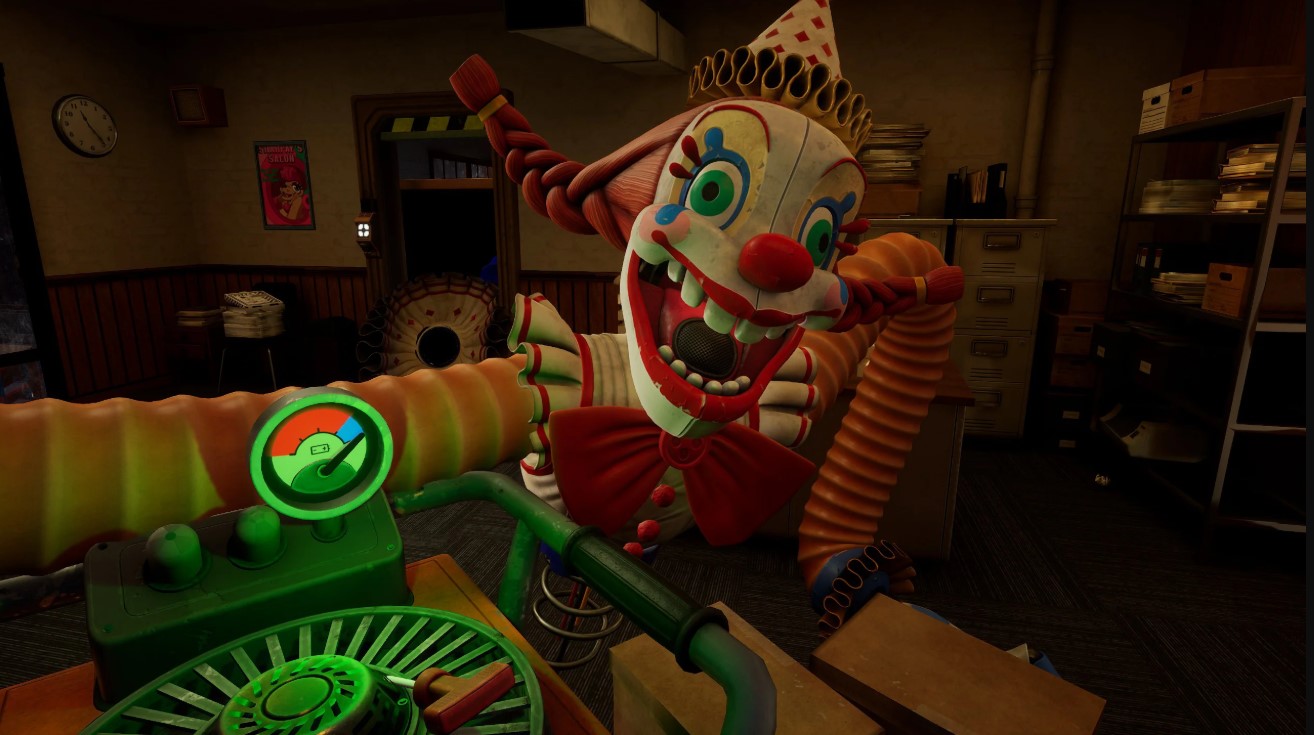
The threat is the Mimic, a prototype endoskeleton that can wear and imitate any character. That’s the hook the whole design hangs on. In earlier games you learned an animatronic’s behaviour and then exploited it. Here the thing hunting you keeps changing what it looks like, so pattern recognition only gets you so far.
Five hours, roughly, for a first run through the story. Shorter than people expected from a full-price release in 2025, and one of the fairer criticisms levelled at it.
How FNAF Secret of the Mimic Actually Plays
Here’s the part that reviews undersold. It’s a stealth game with a toolkit, not a reaction-time game.
The Data Diver is your core device – a diagnostic tool that opens sealed doors and pulls information out of the facility’s systems. It’s also your progression gate, since Diver-accessible rooms are generally safe ones.
Around that sit the improvised solutions:
- Lockers are your primary hiding spots, and the audio design does the heavy lifting – footstep volume tells you exactly how close the Mimic is.
- Speaker standees are cardboard cutouts you can switch on to play music, pulling the Mimic toward the noise and away from you.
- Wind-up mice come from the security office and work as portable distractions, though they don’t travel far, so placement needs planning rather than panic.
- Inventory terminals mark safe rooms where you can breathe and reorganise.
- Your own route knowledge is the real tool, because the Manor loops back on itself constantly.
The first proper encounter is a good teacher. You restore power, crank open a folding gate, and the Mimic arrives. The correct response is to run immediately – turn around, right, right again, and get into the locker. Wait for the footsteps to recede, trigger a standee, then loop back to the breach point and let the Data Diver take you onward.
That sequence teaches the whole grammar of the game in about ninety seconds. Run, hide, listen, distract, reposition. Everything afterwards is a variation.
The Three Endings, Handled Carefully
Mild structural spoilers follow – I’ll describe what the endings require without walking through the story beats that lead there.
| Ending | How You Get It | Difficulty |
|---|---|---|
| Bad | Follow dispatch’s instructions and hand over the Data Diver | The default, if you do as you’re told |
| Normal | Run PARACHUTE.EXE from the H.E.L.P.E.R computer with executive permission, then activate CRADLE.EXE and escape | Requires deliberate off-script action |
| Secret | New Game+, all 25 hidden collectibles, the MOON.EXE minigame, every tape, and a colour-sequence puzzle in David’s bedroom | A second full playthrough with a checklist |
The Bad ending is the clever one from a design standpoint. You get it by being a good employee. Dispatch tells you to deliver the Diver, you deliver it, and the consequence of competent obedience is that you end up in a costume. That’s a sharper piece of writing than it gets credit for – and it’s the ending most first-time players see, because why wouldn’t you follow the instructions you were given?
The Secret ending is the one the community organised around for weeks after launch. Twenty-five collectibles spread across the levels, a New Game+ requirement, a minigame, and a specific colour order played through a pedestal. It’s a lot of homework. It also contains the material that actually moves the series’ lore forward, which is why the collectible-hunting guides exploded the way they did.
The Lore Payload
Heavier spoiler territory now. Skip to the ports section if you’re going in fresh.
The reason this game mattered to the fanbase isn’t the stealth. It’s that it finally explains the Mimic properly, and the explanation is sadder than anyone expected.
Edwin Murray built a Modular System and produced two artificial intelligences from it.
M1 was made as a replica of Fiona, Edwin’s deceased wife, intended to care for his son David. She tried to communicate with Edwin repeatedly and was ignored every time. She eventually became F10 N4 – the facility’s security system. Read that designation out loud if it hasn’t landed yet.
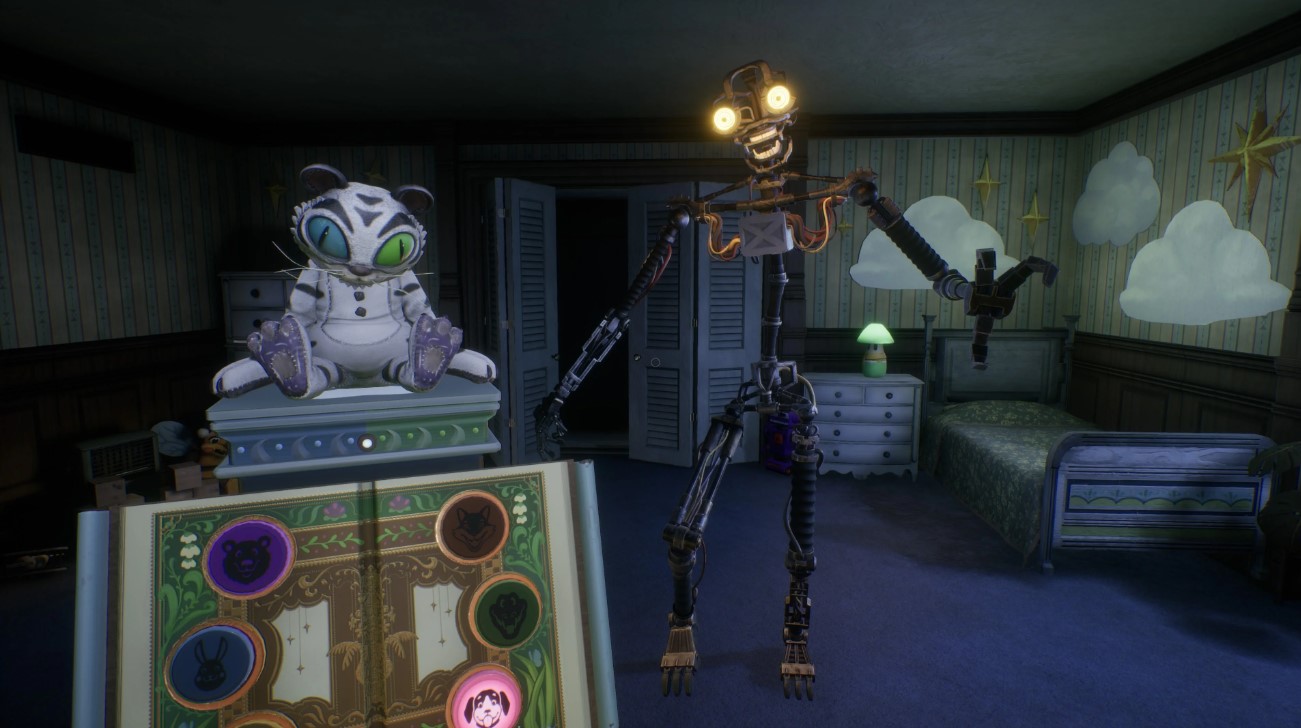
M2 started by copying a white tiger doll meant to comfort David. After David died at five years old, M2 began imitating the boy instead. What it learned from Edwin afterwards was neglect, and what neglect taught it was rage. Edwin’s disappearance follows from there.
That’s the engine of the whole thing. Two machines built out of grief, one ignored into obsolescence and one ignored into violence. The series has circled themes like this for a decade, usually through cryptic minigames and fan theory crawls. Putting it in a playable facility with tapes and a bedroom and a bedtime story is a different kind of storytelling, and it’s the most emotionally direct FNAF has been.
Whether the Secret ending is canon is still argued about, incidentally. The community hasn’t settled it and neither has Scott. Treat any site telling you definitively as guessing.
The Port Nobody Expected to Work
Getting Secret of the Mimic onto Switch required more than turning settings down. Devoted Studios handled the port, and in an April 2026 writeup the team laid out what it actually took.
The bottleneck wasn’t graphics. It was memory, loading and navigation mesh calculation – and the nav mesh work was running on the main thread. Their fix was to rewrite it to run asynchronously, which Unreal Engine 4 barely supports, meaning direct engine modifications.
They also swapped hard asset references for soft ones so things load on demand, built minimal transition levels so old areas could unload safely before new ones arrived, retuned memory pools, shrank assets and materials, and brought in Unreal’s IoStore system for faster level transitions. Loading spinners got added where sublevels couldn’t keep pace during slow mode, which Nintendo’s certification required.
Why does any of that belong in an article about whether to buy the game? Because it tells you the Switch version isn’t a lazy afterthought. Somebody rewrote engine behaviour to make it run. If you were weighing the handheld version against the PC one, that’s the context you needed.
What It Gets Right, and Where It Wobbles
Honest column, because the critical split was real and pretending otherwise helps nobody.
What works:
- Atmosphere and sound design, which is close to series-best – the audio tells you everything and the Manor feels genuinely abandoned rather than set-dressed.
- A threat that changes shape, which keeps the stealth loop from becoming a solved puzzle.
- Lore delivered through a place rather than through a wall of text or a theory channel.
- Multiple endings with real effort tiers, where the hardest one actually pays off.
- The 1979 setting, which sidesteps the continuity knots of the later timeline.
What doesn’t:
- Length. Around five hours for the main story is thin at $39.99, which is a large part of why the current sale changes the calculation.
- Mechanical polish. The common critical note was a game caught between the old formula and a newer one, never fully committing to either.
- Appeal outside the fanbase. Several reviewers landed on the same conclusion: it rewards investment in the series and gives much less to anyone without it.
- Scripted stretches that sit awkwardly beside the systemic hiding sections.
That middle criticism is the fairest one. There are moments where the game wants to be an immersive-sim-lite stealth experience and moments where it wants to be a corridor with a scare at the end, and it doesn’t always choose.
Who Should Buy It at $19.99
If you follow the lore: buy it, and go for the Secret ending. This is the game that explains the Mimic, and no amount of video essays substitutes for finding the tapes yourself. The twenty-five collectibles are a chore but they’re the point.
If you like stealth horror and don’t care about FNAF: worth it at half price, probably not at full. The hiding-and-distraction loop is solid and the Manor is a strong location. You’ll miss most of the emotional weight, which is a real loss.
If you’re buying for someone younger who’s into the series: it’s the most approachable modern entry in terms of structure, and the Switch version runs properly thanks to the work described above.
The sale ends October 8. That’s the only genuinely time-sensitive thing in this article, and it’s the reason the maths currently favours buying.
FAQ
When did Secret of the Mimic come out?
June 13, 2025, on PC and PS5, then Xbox Series X|S and Switch on December 16, 2025, with Switch arriving in Europe on January 12, 2026.
How long is it?
Roughly five hours for the main story, longer if you’re hunting collectibles for the Secret ending.
How many endings are there?
Three – Bad, Normal and Secret. The Secret one needs New Game+ and all 25 collectibles.
Who do you play as?
Arnold, a technician sent into Murray’s Costume Manor in 1979 to retrieve Edwin Murray’s schematics.
Is there VR support?
Yes, on PC through SteamVR.
Does it explain the Mimic’s origin?
It does. Two AIs, M1 and M2, both built by Edwin Murray out of grief over his wife and son.
Is it worth playing without knowing the series?
The stealth holds up on its own, but most of what makes it land depends on series context.
The Game Aged Better Than Its Launch Week
Secret of the Mimic came out carrying years of accumulated theorising about a character the fanbase had turned into a legend, and no game can satisfy that. The critical reviews measured it against polished contemporary horror and found it uneven, which is accurate. The fanbase measured it against a decade of waiting and found it moving, which is also accurate.
What’s left sixteen months on is a game with a great location, an unusually sad story, and a hiding mechanic that genuinely works – sold now at a price that matches its length. The ports are solid. The community guides are mature. Nobody’s shouting about it anymore, which is frankly the best condition in which to play a horror game.
Go sit in a locker and listen to the footsteps. That part was always the good bit.
If this saved you from either overpaying or missing the window entirely, pass it along on X, Reddit, or whichever Discord still argues about Mimic canon at 2 am – small writing teams travel by word of mouth and nothing else. Bookmark it as well, because the canon debate isn’t finished and we revise this page rather than filing a new one each time something shifts. And if creative or commercial collaboration is what brought you here, write to the Lizet Manski team directly – we answer every message, and we never hide in the costume.