
Amethyst Shard in Minecraft and the Sparkly Purple Treasure Underground
Picture it. You’re mining deep underground, chipping through boring gray stone, when suddenly your pickaxe breaks into a hollow chamber glittering with purple crystals. A soft chime rings out as light dances off the walls. You’ve struck an amethyst geode – one of the most beautiful sights in all of Minecraft. And tucked inside are the shards that power some genuinely useful gear. The amethyst shard in Minecraft is a mid-game treasure worth seeking out.
Here’s the thing though – amethyst works differently from every other resource in the game, and that trips up a lot of players. You can’t just mine it once and take the whole farm home. There are growth stages, specific tools, and a renewable system that Mojang deliberately designed to keep you coming back. Get it wrong and you’ll destroy your own supply. Get it right and you’ve got an endless source of purple crystals.
So let me walk you through everything about the amethyst shard in Minecraft – how to find geodes, harvest shards correctly, set up a renewable farm, and every single crafting use from spyglasses to Allay duplication. Grab your pickaxe. Let’s go crystal hunting.
What Is an Amethyst Shard in Minecraft?
Quick primer first, because understanding what amethyst is unlocks the whole system. The amethyst shard is a purple crystal item introduced in the 1.17 Caves & Cliffs update. It’s a valued crafting ingredient that you gather rather than craft – you can’t make a shard at a crafting table or furnace, only obtain it by mining.
Amethyst comes from special underground structures called geodes, and the whole thing works on a growth cycle. Here’s the key vocabulary you need:
- Amethyst geode – the hollow underground structure where amethyst generates.
- Budding amethyst – the special block that grows crystals; it cannot be moved or obtained.
- Amethyst buds – the three early growth stages (small, medium, large) that produce nothing.
- Amethyst cluster – the fourth and final stage, which drops the shards you want.
- Amethyst shard – the crystal item itself, used in crafting.
That budding amethyst block is the heart of the whole system. Crucially, it cannot be moved by pistons and cannot be obtained even with Silk Touch. As Mojang developer Cory Scheviak explained, this was completely intentional – they confined crystal growth to the immovable budding amethyst so that players have a reason to return to the geode over and over, rather than mining it once and moving the farm home. It’s a deliberate design choice that makes geodes permanent farming sites.
How to Find an Amethyst Shard in Minecraft?
Alright, let’s get you some shards. The first step is finding a geode, and knowing where to look saves a ton of digging. Here’s the practical rundown.
Amethyst geodes generate underground in the Overworld, spawning between roughly Y-level -64 and Y-level 30. So while they can appear as deep as diamonds, you don’t necessarily need to dig to the bottom of the world. Just head underground and start exploring caves or branch mining within that range.
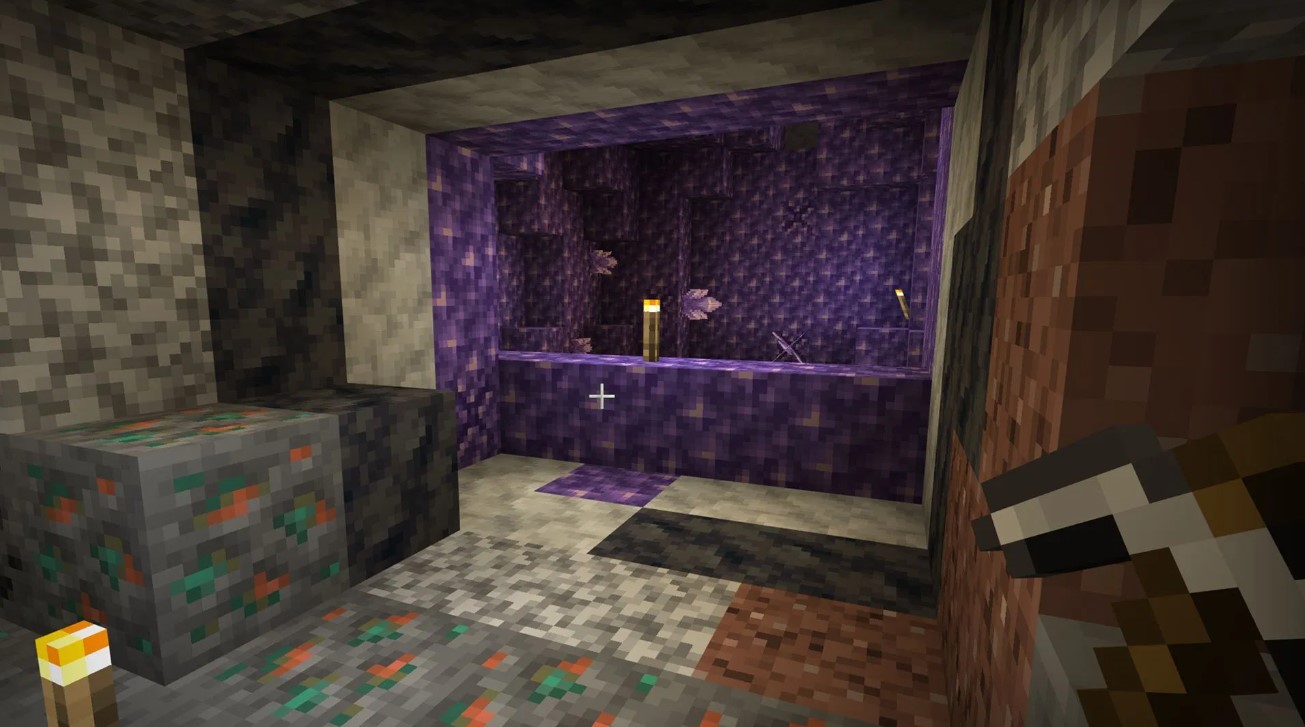
Geodes have a distinctive three-layer structure that makes them recognizable:
- Outer layer – smooth basalt, the dark shell surrounding the whole geode.
- Middle layer – calcite, a lighter, whitish stone.
- Inner layer – amethyst blocks and budding amethyst, where the crystals grow.
Here’s a handy spotting tip: geodes are large and often cracked, which means you might catch a faint glow or a glimpse of purple from a distance. Keep an eye out for that smooth basalt shell while mining – it’s your signal that a geode is nearby. When you break through the basalt and calcite layers, you’ll reveal the glittering amethyst chamber inside.
And the single most important tip the whole community stresses: save the geode’s location. Since you’ll want to return repeatedly to harvest regrown clusters, mark it somehow – with a beacon, a distinctive tower, coordinates written down, whatever works for you. A geode isn’t a one-time loot spot; it’s a renewable resource you’ll visit again and again.
Beyond geodes, amethyst shards can also occasionally be found in chests in ancient cities and trial chambers, so keep an eye out while exploring those structures too.
Harvesting the Amethyst Shard in Minecraft Correctly
Now for the part that trips people up most. How you mine amethyst matters enormously, and doing it wrong either destroys your farm or costs you shards. Let me break down the correct method.
The golden rule: only fully grown amethyst clusters drop shards. The three earlier bud stages (small, medium, large) produce absolutely nothing when broken. So you must wait for a cluster to reach its final growth stage before harvesting. Break a bud early and you’ve wasted it.
Here’s how the drops work when you mine a fully grown cluster:
- Pickaxe (no enchantment) – drops 4 amethyst shards, the standard yield.
- Any other tool, hand, or mechanism – drops only 2 shards.
- Piston or explosion – also only 2 shards.
- Silk Touch pickaxe – drops the cluster block itself, not shards.
That means you should always use a regular pickaxe to get the full 4 shards. And here’s where it gets lucrative: the Fortune enchantment dramatically boosts your yield. Fortune III can drop up to 16 shards from a single cluster, averaging around 8.8 shards per cluster. Fortune I averages about 5.3, and Fortune II about 7. So a Fortune III pickaxe is genuinely worth using for serious amethyst farming.
There’s a fascinating quirk here that the community loves. Because Fortune boosts manual mining but automated (piston-based) harvesting only yields 2 shards, manual farming with Fortune III actually produces more amethyst than automatic farming. That’s unusual in Minecraft, where automation usually wins. For amethyst, your enchanted pickaxe beats a machine. Nice to know.
Setting Up a Renewable Amethyst Farm
Here’s the beautiful part: amethyst is completely renewable, so you can set up a farm for endless shards. Since budding amethyst keeps growing new clusters indefinitely, one geode can supply you forever. Let me cover the basics of farming it.
The fundamental principle is simple. Buds and clusters only grow when planted on budding amethyst blocks, and those blocks stay in the geode. So your farm is the geode. You harvest the mature clusters, then wait for the budding amethyst to grow fresh ones, and repeat.
Here are the key steps to a good manual farm:
- Clear the area – dig out all the calcite, smooth basalt, and stone around the budding amethyst, and block off nearby caves.
- Light it up or waterlog – prevent mob spawns, and note that amethyst grows fine underwater if the geode is submerged.
- Wait for growth – buds progress through their stages over time until they become harvestable clusters.
- Harvest with Fortune III – return periodically and mine the mature clusters for maximum shards.
- Leave the budding amethyst intact – never break it, since it’s the engine of your whole farm.
A popular community tip is to build platforms or floors within the geode using ladders for easy access to all the budding amethyst blocks. Underwater geodes are especially efficient farms once set up, since the water handles some of the tedium. Whatever method you choose, the payoff is a permanent, renewable supply of amethyst shards. Just remember: patience is required, since the crystals take real time to grow.
One clever bonus: you can use Allays to help collect the shards. These friendly mobs pick up dropped items, so having a few Allays around your geode makes harvesting less tedious. And fittingly, you duplicate Allays using amethyst shards themselves.
Every Use of the Amethyst Shard in Minecraft
Now for the payoff – what can you actually do with all these shards? More than most players realize. Amethyst is far more useful than just a pretty decoration. Let me run through every use.
Here are the crafting recipes and functions:
- Spyglass – 1 amethyst shard on top of 2 copper ingots; lets you zoom in to scout distant terrain, mobs, and villages.
- Tinted Glass – 1 glass block surrounded by 4 shards (in a plus shape), yields 2; blocks light but stays see-through, great for mob farms.
- Block of Amethyst – 4 shards in a 2×2 grid; a decorative block that chimes pleasantly when walked on.
- Calibrated Sculk Sensor – a sculk sensor plus amethyst shards; a redstone component that detects vibrations by frequency.
- Allay Duplication – give a shard to an Allay dancing near a jukebox to create a copy (5-minute cooldown).
- Armor Trims – since 1.20, use shards with smithing templates to add purple color accents to your armor.
That’s a genuinely versatile list. The spyglass is arguably the most popular use – it finally gave Minecraft a vanilla way to zoom in, which fans had wanted for years. The tinted glass is a builder and redstone favorite because it blocks all light while remaining transparent, perfect for dark mob-spawning rooms or aesthetic builds, and it can be broken and reused without Silk Touch unlike regular glass.
The calibrated sculk sensor opens up advanced redstone possibilities, letting you filter vibrations by frequency for traps, alarms, and wireless circuits. There’s also a neat related mechanic called vibration resonance – placing amethyst blocks against sculk sensors lets them transmit signals to other sensors up to 14 blocks away, a game-changer for compact redstone contraptions.
And don’t forget the simple joys: amethyst clusters and buds emit light (clusters give off light level 5), and amethyst blocks make lovely chiming sounds, making them fantastic for atmospheric, aesthetic cave bases and decoration. The purple crystal look is genuinely gorgeous.
Tips for Making the Most of Amethyst
Let me leave you with some practical wisdom for getting the most out of your amethyst adventures, drawn from community experience. These pointers save time and shards.
First, always carry a Fortune III pickaxe when harvesting. Given that it nearly triples your average yield over a plain pickaxe and beats automated farming, it’s the single best way to maximize your shard collection. Enchant a dedicated amethyst pickaxe and keep it handy.
Here are more tips worth knowing:
- Mark your geode clearly so you can return easily for repeat harvests over your whole playthrough.
- Never mine buds early – only fully grown clusters drop shards, so patience pays off.
- Bring Allays to auto-collect your dropped shards and speed up harvesting.
- Consider an underwater geode for a lower-effort renewable farm.
- Don’t waste Silk Touch on clusters unless you specifically want the cluster block for decoration.
That “don’t waste Silk Touch” point catches people out. Silk Touch drops the cluster block itself rather than shards, so if you want the crafting material, use a normal or Fortune pickaxe instead. Only reach for Silk Touch if you’re collecting clusters to decorate with, since they can then be placed on any solid block.
And finally, think about what you actually need the shards for before going on a massive farming spree. A spyglass needs just one shard; a full armor trim or a big tinted-glass build needs many.
Match your farming effort to your goals, and you won’t waste time hoarding purple crystals you don’t need. Though honestly, they look so nice that hoarding them for decoration is a perfectly valid choice too.
FAQ
How do you get amethyst shards in Minecraft?
Mine fully grown amethyst clusters inside geodes, which spawn underground between Y-level -64 and 30. A pickaxe drops 4 shards; Fortune III drops up to 16.
Can you craft amethyst shards?
No. Shards can only be obtained by mining amethyst clusters or found in ancient city and trial chamber chests. You can’t make them at a crafting table.
Why aren’t my amethyst buds dropping shards?
Only fully grown clusters (the fourth stage) drop shards. The three earlier bud stages produce nothing, so you must wait for them to mature.
Are amethyst shards renewable?
Yes. Budding amethyst keeps growing new clusters indefinitely, so a geode is a permanent, renewable source of shards you can farm forever.
What can you make with amethyst shards?
Spyglasses, tinted glass, blocks of amethyst, and calibrated sculk sensors. Shards also duplicate Allays and add purple armor trims.
Should I use Silk Touch or Fortune on amethyst?
Use Fortune for maximum shards (up to 16 with Fortune III). Silk Touch drops the cluster block itself, only useful for decoration.
Where do amethyst geodes spawn?
Underground in the Overworld between Y-level -64 and 30. Look for the smooth basalt shell and calcite layer, often with a visible crack or glow.
Wrapping It Up
This gorgeous purple crystal, gathered from geodes deep underground, powers some of the game’s most useful items – the zoom-in spyglass, light-blocking tinted glass, decorative amethyst blocks, calibrated sculk sensors for redstone, Allay duplication, and armor trims. And thanks to renewable budding amethyst, you’ll never run out.
My honest advice? Find a geode within Y-level -64 to 30, mark its location so you can return, and always harvest fully grown clusters with a Fortune III pickaxe for the best yield. Set up a simple manual farm, bring some Allays to collect drops, and never break the budding amethyst that grows your crystals. Do that, and you’ll have an endless supply of shards for whatever you want to build or craft.
Amethyst proves that some of Minecraft’s most rewarding resources are the ones that make you work a little for them. The hunt for that glittering purple geode never stops being satisfying, and the shards inside unlock genuinely handy gear. Now go find your geode and start collecting – the crystals are waiting.
P.S. Here’s your fully grown cluster of gratitude: if this guide zoomed in on exactly what you needed like a freshly crafted spyglass, send it chiming across your social feeds so fellow miners can strike purple too, and pin it to your bookmarks like a geode location you’ll want to return to again and again. Every share is basically a Fortune III enchantment that multiplies our team’s motivation to keep digging up great guides. And if you’re seeking creative or commercial collaboration, the Lizet Manski team is one message away – reach out directly and let’s grow something brilliant together.