
The Castlevania Legends Game on Trial: Opening Statement
Picture the timeline as a family portrait hanging in a castle hallway. Simon’s there. Trevor, Richter, Juste, Leon at the far left where the frame begins. And there’s a rectangle of slightly darker wallpaper where somebody’s picture used to hang. That’s Sonia Belmont. And the story of how she got taken down is stranger, sadder, and honestly funnier than most of the actual Castlevania plots. Let’s set the scene properly, because the timing here is almost cruel.
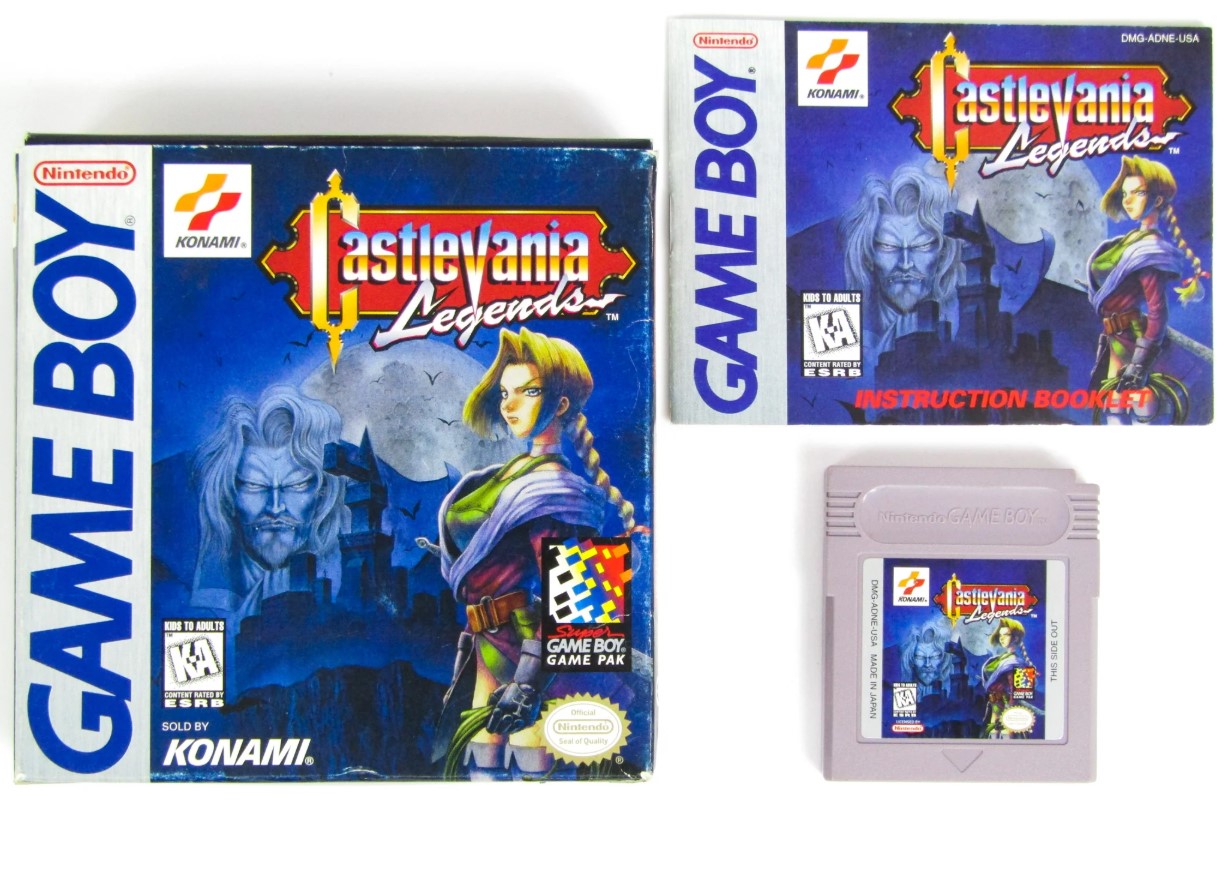
November 27, 1997, in Japan. March 11, 1998, in North America and Europe. A Game Boy cartridge lands on shelves with the title Castlevania Legends, developed by Konami Computer Entertainment Nagoya – a different studio from the teams that made the earlier handheld entries.
Now look at what it was standing next to. Symphony of the Night had shipped only months earlier and rewired what people thought this series could be. Pokémon was busy proving the Game Boy had years of life in the tank. Into that room walks a monochrome, six-stage, whip-’em-up prequel that looked and played like it had been made in 1991.
The pitch, though, was enormous. This was going to be the beginning of everything – the first Belmont to ever raise a whip against Dracula, the origin of the bloodline, the seed of every game that came after. A female protagonist headlining a Castlevania for the first time, years before Shanoa showed up in Order of Ecclesia.
The Case for the Defense: What the Castlevania Legends Game Got Right
Here’s the part that gets buried under decades of dunking. This game tried things. Some of them were genuinely good ideas.
The sub-weapons are gone. Radical call, and a divisive one. No axe, no cross, no holy water in the traditional sense. Instead, Sonia earns Soul Weapons from the bosses she kills, selected from a menu with the SELECT button and paid for in Hearts. Wind freezes enemy movement and attacks outside of boss fights. Ice restores your entire life gauge for 20 Hearts – which, let’s be honest, is absurdly strong for a Game Boy action game. Fire, and the rest, round it out.
The classic sub-weapons weren’t erased entirely, mind you. They were hidden across the stages as collectibles, which is a big part of why the level layouts fork into so many branching paths and dead ends. Whether that exploration is rewarding is a separate argument. The intent was there.
Burning Mode is the real headline feature. Press A and B together and Sonia ignites – invincible, stats roughly doubled, tearing through anything in front of her for as long as the burning gauge holds. It’s usable once per life per stage.
And it feels great. Every walkthrough written for this game says the same thing: bank it, save it for the boss, then delete them. Bosses in this game don’t show a health bar, so you’re swinging in the dark, and Burning Mode is the flashlight. That’s a genuinely smart bit of design tension – an invincibility button with a hard budget attached.
Sonia herself. She can crawl, which Christopher Belmont couldn’t do in the earlier Game Boy games, and it’s required to squeeze through cramped corridors and dodge certain hits. She’s got a backstory with actual texture: born able to sense spirits invisible to ordinary people, trained with the whip by her late grandfather. Even the game’s harshest critics tend to admit she’s the one thing worth showing up for.
There are two difficulty options too. Light Mode starts you with the whip fully upgraded so you can just enjoy the ride. Standard Mode makes you earn it. For a 1997 handheld game, that’s more player-facing consideration than the reputation suggests.
The Case for the Prosecution: Why the Castlevania Legends Game Bombed
Right. Now the ugly part, and I’m not going to soften it, because the community never has.
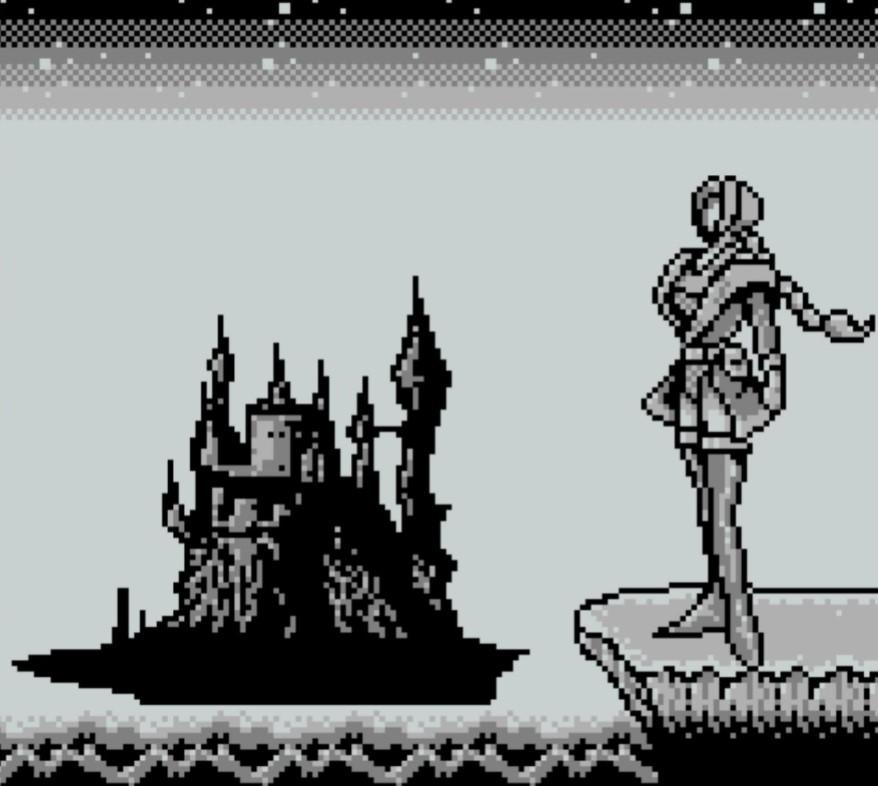
The presentation is thin. Sparse backgrounds, unremarkable enemy designs, level layouts that feel less like designed spaces and more like corridors that happen to exist. Compared to Belmont’s Revenge, which came out six years earlier on the same hardware and looked genuinely handsome doing it, Legends is a step backwards. That’s the specific thing that stings – not that it’s a weak Game Boy game in isolation, but that the series had already done better on this exact console.
Then there are the stage timers. Six timed stages, each capped off with a boss. Pits that kill you, trap rooms that kill you instantly, and a clock ticking the whole way. It turns exploration into a stressful chore, which is a weird choice for a game that hid all its sub-weapons in optional dead ends. You’re being asked to explore and to hurry, simultaneously, and those two instructions fight each other the entire runtime.
The controls are stiff even by the standards of a series famous for committed, no-take-backs jumping. Community write-ups aren’t kind here. One long-running retro blog described it flatly as better than the original Castlevania Adventure, which is a low bar it does clear, while still concluding it doesn’t hold up. On the ResetEra thread where fans tried to work out why Igarashi soured on it, the level design got picked apart as feeling like it came from someone unfamiliar with how these games are built.
Some of that is fandom hyperbole, sure. Not all of it.
| Element | How it lands |
|---|---|
| Soul Weapons system | Clever idea, undercooked execution |
| Burning Mode | Genuinely great, best thing in the game |
| Sonia as a protagonist | Strong concept, underserved by the game |
| Level design | The weakest link by a distance |
| Stage timers | Actively fights the exploration design |
| Visuals and enemy art | Sparse, behind its own predecessor |
| Boss fights | Easy, with no health bars to read |
| Story ambition | Enormous, and that’s the problem |
The Retcon: How a Whole Game Got Deleted
So Legends is a mediocre handheld game. Fine. The series has survived worse. Simon’s Quest exists and nobody erased it.
That’s the thing people get wrong about this story. Legends wasn’t removed because it was bad. It was removed because of who Sonia slept with.
Let me back up. When Koji “IGA” Igarashi took over as series producer and set about building one coherent official timeline, he pulled several entries out of the main chronology – Legends, the Nintendo 64 games, Circle of the Moon. His stated reasoning wasn’t a quality judgment. He framed the removed titles as side stories, “gaiden” style entries sitting alongside the main line rather than inside it.
But Legends had a specific, unfixable problem. The plot makes Alucard – Dracula’s own son – Sonia’s love interest, and the ending strongly implies he fathered her child, who carries the Belmont legacy forward. Do the math on that and every Belmont in the series is descended from Dracula.
That’s not a minor continuity wrinkle you can hand-wave in a footnote. It rewrites the fundamental premise of the entire franchise, which is a human bloodline standing against a monster. Early Konami timelines dated the game’s events around 1400 or 1450 and treated it as the origin point. Later versions took it out at Igarashi’s request.
Lament of Innocence, released in 2003 and set in 1094, became the official beginning instead. Leon Belmont took the crown as the first Belmont vampire hunter. Sonia was gone.
Igarashi wasn’t gentle about it either. He publicly called the game an embarrassment for the series and said it completely ignored Castlevania’s look, positioning it as existing in an alternate world outside the official history. Whatever you think of the decision, he never pretended it was anything other than a decision.
And here’s the part that stings for people who care about Sonia. She was set to headline again. Castlevania: Resurrection was in development for the Dreamcast with her in a starring role, and then it got cancelled. So the retcon didn’t just close her book. It closed it while the sequel was still being written.
Where Sonia Went After the Erasure?
You’d think that’s the end. It isn’t, and this is where the story gets genuinely nice.
Sonia never quite died in the fandom. She kept showing up in discussions, fan art, and “who deserves a comeback” threads for decades, precisely because being erased made her interesting. A character nobody plays is forgettable. A character somebody deliberately removed is a mystery.
Then in 2024, Vampire Survivors dropped its Ode to Castlevania DLC – a genuinely enormous crossover that added dozens of characters from across the entire series – and Sonia Belmont was right there in the visible roster. Not hidden. Not a secret unlock buried behind twenty hours. Standing alongside Leon Belmont, the man who replaced her.
That placement is a small act of grace, and fans clocked it immediately. Both “first Belmonts,” side by side, the official one and the deleted one, treated as equally real.
Her kit is fun, too:
- Her starting weapon is the Sonic Whip, a short-range close-quarters tool that players took to fast enough that PC Gamer wrote about grinding the DLC’s sprawling map specifically to get it.
- She begins with a movement speed bonus and a luck bonus, making her a strong pick for hoovering up stage pickups.
- Her signature passive triggers on overhealing – heal past your maximum by enough and she gets a temporary Rapid Fire buff, which turns into a sustained damage engine if you build around healing.
- Unlocking her means opening the Stallion Gate, then collecting seven Heart Refresh items, which stack across multiple runs so you can chip away at it casually.
- Her theme is a remix of Bloody Tears, which is about as unsubtle a statement of “she belongs here” as a soundtrack can make.
Twenty-seven years after Konami wrote her out, a different studio’s crossover put her back in and gave her the most famous song in the series. Games are weird and occasionally lovely.
There’s a wrinkle in progress, too. Reports circulated in 2026 that a storefront listing for the upcoming Castlevania: Belmont’s Curse briefly named Sonia as the protagonist before the wording was changed to describe the character as a successor to Trevor Belmont instead. Whether that was a genuine slip, a placeholder, or someone reaching for the most recognizable name available, nobody outside the studio knows. But the fact that fans immediately lit up over it tells you exactly how much unfinished business is attached to this character.
Playing the Castlevania Legends Game Today
Awkward news: it’s hard to do legitimately.
Konami has been generous with re-releases lately. Anniversary Collection, Advance Collection, Dominus Collection in 2024 with the DS trilogy plus a full reimagining of Haunted Castle. Between them, most of the series is playable on modern hardware.
Legends isn’t in any of them. Its absence from the Anniversary Collection kicked off a Steam discussion thread that’s still getting replies years later, with people arguing about whether it deserved a slot over Castlevania Adventure. One recurring point in favor: Legends had Super Game Boy support and a color palette, which is more than a couple of its shelfmates managed.
So your realistic options are a Game Boy cartridge on the secondhand market or emulation, and the cartridge route means a game that never got a wide print run to begin with.
Here’s my honest advice on whether to bother:
- Play it if you’re a completionist, you care about series history, or you want to see the ideas – Burning Mode especially – that never got another shot.
- Skip it if you want a good handheld Castlevania. Belmont’s Revenge is right there, it’s on the Anniversary Collection, and it’s better in every measurable way.
- Split the difference by watching a playthrough. It’s a six-stage game. You can absorb the whole thing in an evening and skip the parts that made everyone grumpy in 1998.
One more tip for anyone actually playing: hold Burning Mode. Every guide says it, and every first-timer burns it on a hallway of zombies and then meets a boss with no health bar. Don’t be that person.
FAQ
Why was Castlevania Legends removed from the timeline?
Because its plot pairs Sonia with Alucard and implies he fathered her child, which would make every Belmont a descendant of Dracula. Igarashi rebuilt the official chronology and cut it out as a side story.
Who is the first Belmont vampire hunter now?
Leon Belmont, from Lament of Innocence, set in 1094. He replaced Sonia as the origin point of the bloodline when the official timeline was formalized.
Is Sonia Belmont canon in any way today?
Not in the main series chronology. But she appears as a playable character in the Ode to Castlevania DLC for Vampire Survivors, complete with a Bloody Tears remix as her theme.
What’s Burning Mode?
A power-up you trigger with A and B together. Sonia becomes invincible with roughly doubled stats for a limited time, once per life per stage. Save it for bosses.
What replaced the sub-weapons?
Soul Weapons, earned from defeated bosses and paid for with Hearts. Ice fully restores your life gauge for 20 Hearts, which is the standout. Classic sub-weapons still exist as hidden collectibles.
Is Castlevania Legends on any modern collection?
No. It’s been left out of the Anniversary, Advance, and Dominus collections, which remains a sore spot in fan discussions.
Was there ever going to be a sequel with Sonia?
Yes. Castlevania: Resurrection for the Dreamcast was in development with her in a starring role, but it was cancelled before release.
Closing Argument
So what’s the verdict on the Castlevania Legends game? Guilty of being mediocre, absolutely – the level design is rough, the timers are a mistake, and it lost a fight with a Game Boy title from six years earlier. But the punishment massively exceeded the crime. Nobody deleted Simon’s Quest for being clunky. Sonia got erased for a story decision made by people who thought they were writing the beginning of everything, and she’s spent nearly three decades in the wallpaper-shaped gap where her portrait used to hang.
That a survivors-like crossover finally handed her Bloody Tears and a whip is a small, strange kind of justice – and if that storefront slip turns out to mean anything at all, the gap in the family portrait might not stay empty forever.
P.S. If you made it this far, you’re exactly the sort of person we write these for, and passing the link along does more for our small crew than any algorithm ever will. Bookmark it as well – this one has a habit of becoming relevant again every time Konami announces something and the “wait, what about Sonia” replies start piling up. And should creative or commercial collaboration be the reason you’re here, the Lizet Manski team welcomes a direct message.