
GTA 6 Heat vs Wanted Level: Two Meters, Two Completely Different Rulebooks
Most players have worked out by now that the stars at the top of the screen aren’t the whole story. What they haven’t worked out is that GTA 6 Heat and Wanted Level are separate systems with separate rules, and that one of them follows you across the entire map regardless of where you go. That second part is the thing costing people runs tonight. You escape a pursuit, clear your stars, drive to the other side of Leonida – and a patrol flags you anyway, because you’re still in the car that got reported.
Here’s the Heat system on its own terms: what it records, why some of it is regional and some of it isn’t, and what actually clears it.
The Distinction That Explains Everything
| Wanted Level | Heat | |
|---|---|---|
| What it measures | How hard police are responding right now | What police know and remember about you |
| Shown as | Up to six stars | Red icons, plus a purple map overlay |
| Lifespan | Ends when the pursuit ends | Persists after the stars clear |
| Scope | Your current situation | Regional, and partly portable |
| Cleared by | Escaping the search | Removing identifiers and waiting |
Wanted Level is the volume knob. GTA 6 Heat is the case file. You can have zero stars and significant Heat – that’s the state most people misread as “I got away.” The pursuit ended; the investigation didn’t.
The Four Star States, Including the One Nobody Mentions
The stars changing colour is new to the series, and there are four states rather than the two most coverage describes:
- Solid – police have you in line of sight and are actively pursuing.
- Flashing – you’re close to losing them. The pursuit is breaking down.
- Hollow – they have no usable description of you. This is the safest active state.
- Red – lingering Heat. The stars aren’t an active pursuit any more; they’re the residue of one.
That red state is the one that catches people out, because it looks like a wanted level and behaves like a memory. Hovering your map cursor over a hotspot still shows that lingering star while police work the scene.
What Goes Into Your Heat Record
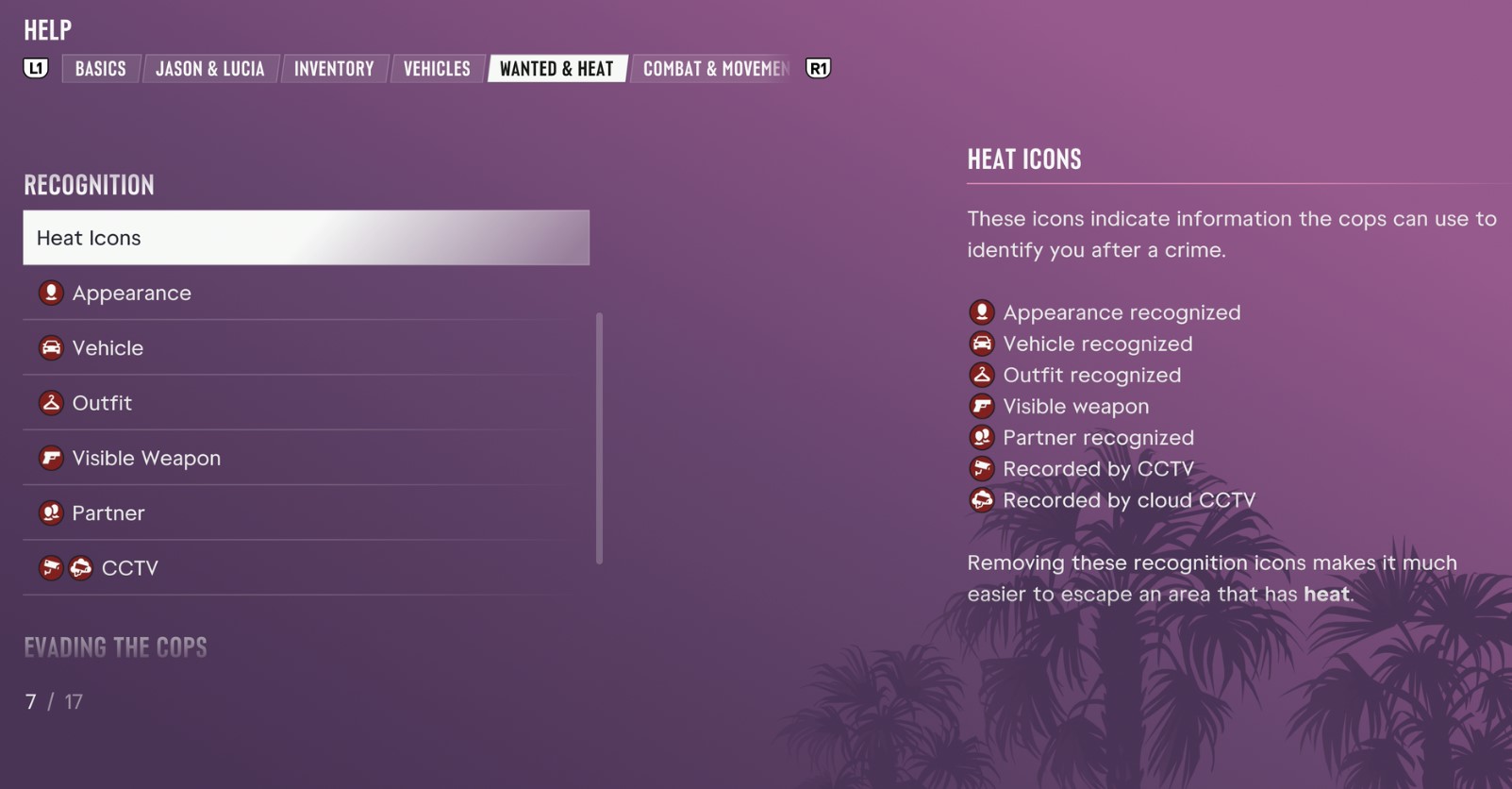
When a crime gets reported, the police build a description. That description is your Heat, and it’s assembled from:
- Your face and general appearance.
- Your clothes at the time of the crime.
- Your vehicle, including its colour and model.
- The weapon you were seen using.
- Whether you were travelling as a pair – Jason and Lucia together is a distinctive description.
- CCTV footage of the act, where cameras caught it.
Each of these is a thread police can pull. The more threads, the faster they re-identify you, and the more work it takes to go cold.
GTA 6 Heat Comes in Two Kinds, and This Is the Important Part
Here’s the insight that reframes the whole system.
Some Heat is attached to a place. Some Heat is attached to you. Rockstar North co-studio head Rob Nelson explained the mechanic to Famitsu using a stolen car example. Officers search a designated Heat area based on the description they have. Leave that area, and the pursuit within it ends.
But – and this is the asterisk – a vehicle police have already flagged stays risky wherever you drive it. That Heat isn’t regional at all. It’s in the car, and the car goes where you go.
Same logic applies to clothing that was part of the report. Crossing a district boundary doesn’t change what you’re wearing. So you’re really managing two problems with different solutions:
Regional Heat is solved by distance and time. Portable Heat is solved by changing the thing that identifies you.
Players treating everything as regional keep driving further away and wondering why it isn’t working.
Regional Heat: The Purple Overlay
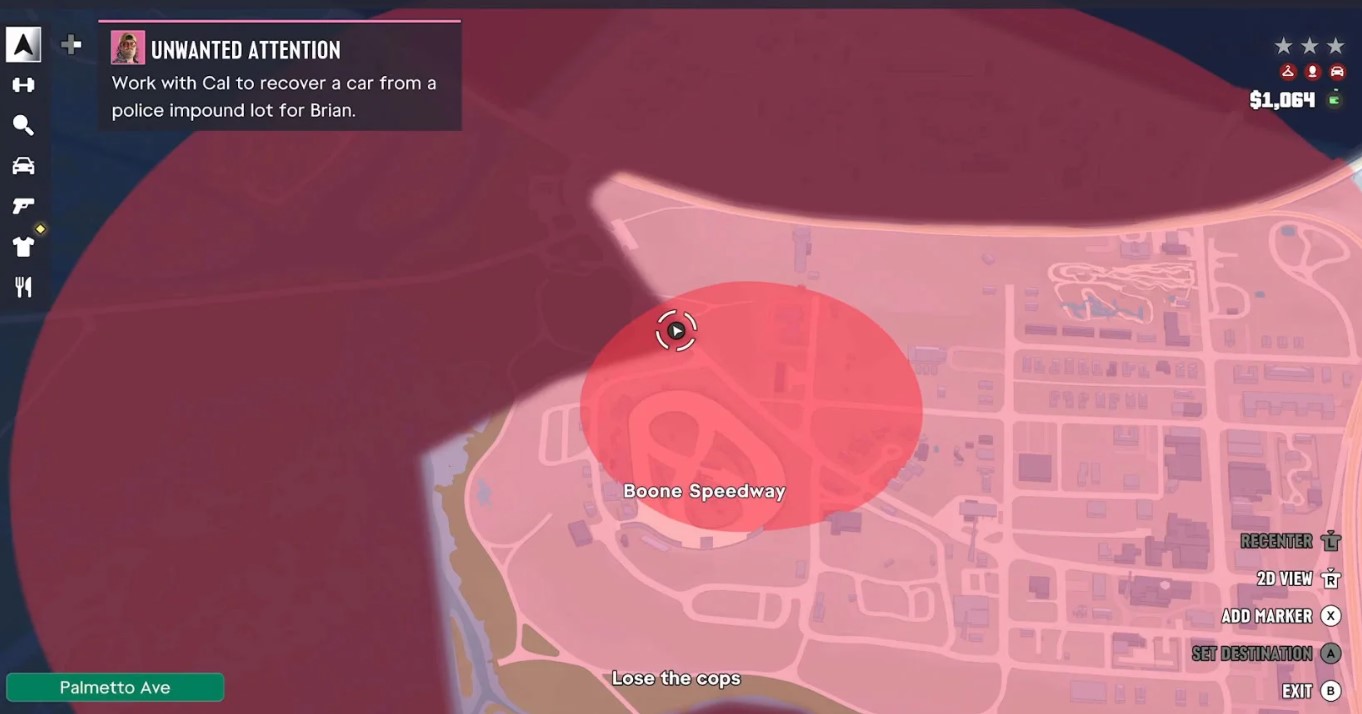
Commit enough crime in one district and that area becomes a Hot Area, shown as a purple overlay on your map.
What that means practically:
- Patrols increase there and stay increased after your stars clear.
- Police in that zone actively watch for your known description rather than patrolling generically.
- Officers hold a perimeter around a robbed store specifically, for a while afterwards, in case you return.
- Repeated offences raise the area’s Heat level – it accumulates rather than resetting.
- Returning too soon can reignite your wanted level even if you arrived clean.
The purple overlay is effectively Rockstar telling you to take your business elsewhere. It’s a deliberate push toward spreading activity across Leonida instead of farming the same three blocks for an hour.
At six stars, incidentally, the heat zone can cover the entire map. There is nowhere to be regionally cold.
The Rule That Traps People
This one deserves its own section because it’s counterintuitive and nobody mentions it.
Heat does not fade while you’re inside the Heat Area.
Staying put and waiting – the GTA 5 instinct – accomplishes nothing. The timer effectively doesn’t run until you’ve crossed the zone’s edge. Cross it, and pursuing officers fall away and the cooling begins.
So the sequence is:
- Leave the zone first. Not after you’ve dealt with the stars – before.
- Then handle your identifiers. Clothes, vehicle, weapon.
- Then stay out. Cooling requires absence, not just survival.
- Avoid the crime scene specifically. Police linger longest at the exact location, so even a cooled area has a hot centre.
Hiding in an alley inside a Hot Area and waiting for the purple to fade is the single most common wasted twenty minutes in this game right now.
How Long Does GTA 6 Heat Actually Last?
Honest answer: nobody has published a number, including Rockstar.
Nelson’s Famitsu interview describes the mechanic in detail and gives no universal timer for how long a Heat area stays active. The community hasn’t established reliable figures either, because the variables – crime severity, how many offences you stacked, how many identifiers are live – all feed into it.
What’s reasonably established:
- At one or two stars, staying out of sight for roughly 30 to 60 seconds usually decays the wanted level.
- At three stars and above, the decay timer extends significantly, and active evasion beats waiting.
- Area Heat cools gradually with absence and no further crimes in that district.
- The purple overlay fades when the district goes cold.
Expect that to be mapped properly within a week or two as players run controlled tests. For now, treat Heat duration as “longer than you want” and plan around it.
What Actually Clears the GTA 6 Heat Level?
| Identifier | How to Clear It | Notes |
|---|---|---|
| Clothing | Change outfit | Only after breaking line of sight; a clothing store works |
| Vehicle | Pay ‘n’ Spray respray | Nelson confirms repainting helps clear Heat |
| Vehicle (elaborate) | Tuning shop | More extensive paint work needs a proper shop |
| Weapon | Switch or holster it | The reported weapon is the flagged one |
| Accomplice flag | Split Jason and Lucia up | Two people is a distinctive description |
| Area Heat | Leave and stay away | No shortcut; time and absence only |
The Pay ‘n’ Spray detail is worth flagging because it’s a returning series staple with a new job. It repairs and recolours, and Nelson specifically noted that repainting can help clear Heat. Your spare outfits, meanwhile, live in your personal vehicle – so calling your car can be part of going cold, not just transport.
GTA 6 Heat Management as a Long Game
Once you understand that Heat persists, it stops being a chase mechanic and becomes something closer to logistics. A few habits worth building:
- Rotate districts. Don’t run three jobs in the same neighbourhood. Spread them and let each area cool while you work elsewhere.
- Keep a clean car. If you’re planning crime, don’t do it in the vehicle you actually like driving. Flagged cars stay flagged everywhere.
- Carry a change of clothes. Your trunk is storage for exactly this reason.
- Respray proactively. After a job, not after you’ve been spotted again.
- Watch the purple on your map before you plan anything. Knowing where you’re already hot is half the job.
- Split up when it matters. The accomplice flag is free information you’re handing over by travelling as a pair.
- Treat the crime scene as radioactive. Even a cooled district has police lingering at the exact location the longest.
That’s a meaningfully different game from GTA 5, where the optimal strategy was to cause maximum chaos in one place and then drive in a straight line until the circle disappeared.
Why This System Exists?
Worth a moment on design intent, because it explains the friction.
GTA 5’s wanted system had a known exploit: break line of sight, leave the circle, wait. Once players learned it, police stopped being a threat and became a timer. The world had no memory, so there was never a consequence that outlived the pursuit.
Heat gives Leonida a memory. It means repeated crime in one place changes that place. It means the car you’re attached to becomes a liability. And it means “getting away” is a process with steps rather than a line you cross on a map.
Whether you enjoy that depends entirely on whether you wanted police to be an obstacle or an opponent.
FAQ
What’s the difference between Heat and Wanted Level in GTA 6?
Wanted Level is how hard police are responding right now. Heat is what they know and remember about you, and it persists after the stars clear.
What does the purple area on my map mean?
It’s a Hot Area – a district where you’ve committed enough crime that police patrols stay elevated and officers actively watch for your description.
Why do police keep finding me after I escape?
Probably portable Heat. A vehicle police have flagged stays risky anywhere on the map, and clothing from the report identifies you regardless of district.
Does Heat go away if I hide?
Not inside the Heat Area. You have to leave the zone before it starts cooling. Hiding within it accomplishes very little.
How long does Heat last in GTA 6?
No official timer has been published. It cools gradually with absence and no further crimes in that district, but the duration varies with severity.
Does a respray clear Heat?
Rob Nelson confirmed that repainting at a Pay ‘n’ Spray can help clear vehicle Heat. More elaborate paint jobs need a tuning shop.
What do the red stars mean?
Lingering Heat rather than an active pursuit – the residue of a chase that’s already ended, with police still working the scene.
Go Cold Properly
The mental model that makes this click: Wanted Level is a conversation; GTA 6 Heat is a reputation.
You end a conversation by leaving. You change a reputation by changing what people can say about you – and in Leonida, that means the car, the clothes, the weapon, and whether you brought your partner.
Leave the zone, change the description, stay away. Everything else is just driving fast, and driving fast was never the answer here.
If this explained why you keep getting pulled over in your favourite car, pass it on – share it, bookmark it, send it to whoever’s been hiding in the same alley for ten minutes. And if you’ve got a creative or commercial project that needs to run hot, Lizet Manski has no cooldown.