
Infinite Rock Paper Scissors: Seven Rules Sea of Stars Rewrote
Let’s get one thing out of the way immediately, because a lot of pages on this subject are confidently wrong about it. Sea of Stars does not contain a rock-paper-scissors minigame. There is no NPC who challenges you to best-of-three. Mr. Chest in Brisk is a pure gambling table, Wheels is a proper board game with figurines and a campaign, and the carnival in Horloge runs tests of balance, strength, and accuracy. None of them is rock paper scissors.
What the game does contain is a combat system that is rock paper scissors with the hand count taken out – which is why “infinite” is a fair word for it rather than a marketing one. In the playground version, three hands exist, and one throw settles a round. In Sabotage’s version, there are six hands, a single enemy spell can demand any number of them, and you have a fixed budget of throws to produce the whole sequence.
That is the Lock system, and it is the only thing in this game that genuinely deserves the comparison.
| The Six Hands | Damage Type | Who Throws It |
|---|---|---|
| Physical | Sword | Zale, Seraï |
| Physical | Blunt | Valere, Garl, Seraï, B’st |
| Magic | Sun | Zale |
| Magic | Moon | Valere |
| Magic | Venom | Seraï, Resh’an |
| Magic | Arcane | Resh’an, B’st |
Two things worth noticing in that table before we start. Blunt has four owners, and Sun and Moon have exactly one each – which means certain locks are trivially coverable and others depend entirely on one character being alive and having a turn. And healing does not count as a hand at all, along with typeless damage like Resh’an’s Ebb and the Item Roulette.
Rule One Rewritten: There Are Six Hands, Not Three
The obvious change, and the one that makes everything else possible.
Three hands produce a closed loop where every option beats one and loses to one. Six hands with no loop at all produce something different: a vocabulary. Nothing here beats anything. Sword does not defeat Moon. Each type is simply a word, and an enemy spell is a short sentence you have to say back correctly.
That shift from competition to translation is the whole design. You are not trying to out-guess an opponent. You are trying to read a requirement and meet it with the characters you happen to have standing up.
Which produces the first real strategic consequence of the game:
- Party composition is hand coverage. A team with no Sun and no Moon cannot break a Sun or Moon lock, full stop.
- Seraï is the most valuable body in the roster for this specific reason, since she covers Sword, Blunt and Venom on her own.
- Garl is the exception that proves the rule – he throws Blunt and nothing else, and no boost adds a magic type to his attacks.
- Resh’an and B’st both cover Arcane, which makes one of them close to mandatory once Arcane locks start appearing.
Infinite Rock Paper Scissors Rule Two: A Throw Removes a Hand Rather Than Beating It
In the playground version, scissors beats paper and the round ends. Here, matching a lock’s symbol deletes that lock from the sequence and the round continues.
That is a genuinely different verb. You are dismantling rather than winning.
Break some of a spell’s locks and the spell lands weakened. Break all of them and the spell is cancelled outright – the enemy spends its turn doing nothing. And breaking locks generates a significant amount of Combo Points on top, which means the act of defending pays for your offence.
So the honest framing of a Sea of Stars battle is that you are rarely attacking to reduce HP. You are attacking to delete symbols, and the HP damage is a side effect of saying the right words.
Rule Three Rewritten: Your Opponent Announces the Throw in Advance
This is the amendment that makes the system fair rather than cruel.
Enemies do not hide what they need. When one begins casting, the spell appears above it with its locks visible and its timer running. You can see exactly which symbols are required and exactly how many turns you have.
There is no bluffing, no mind games, no reading your opponent’s tells. The information is on the screen and the only question is whether your available turns can cover it.
Each spell also has a fixed lock count rather than a random one. The Wanderer’s Thunder, for instance, always arrives with three. Which means the system is learnable – fight the same enemy twice and you already know what its spell will ask for before it starts casting.
Rule Four Rewritten: One Throw Can Be Two Hands
Here is where the system stops being arithmetic and starts being a puzzle worth solving.
A single action can break multiple locks. Zale’s boosted regular attack counts as both Sword and Sun, so it deletes one of each in one turn. Valere’s Moonerang bounces and can connect several times, so it eats multiple Moon locks on its own. Seraï’s Disorient is a physical Venom-Blunt attack, which covers two columns at once.
Live Mana is the engine behind most of this, and it becomes available after the Elder Mist Trials. A non-boosted regular attack drops one Live Mana onto the field, a sneak attack from behind or with the Graplou drops one at battle start – two if you are carrying the Lucent Crystal – and up to three can sit on the field at a time. One character can absorb up to three of them to boost their next action, which adds a portion of their magic attack and, critically, adds a magic hand to a regular attack: Sun for Zale, Moon for Valere, Venom for Seraï, Arcane for Resh’an and B’st.
Garl, as noted, gets nothing. He is a hammer and he remains a hammer.
The practical habit this creates is distinctive to this game. You deliberately throw away turns on plain regular attacks to stockpile Live Mana, because three Live Mana converted into a two-hand boosted attack breaks more locks than three ordinary turns would.
Combos are the other way to double up. They cost one to three Combo Points, you can hold a maximum of three at a time, and since the Dawn of Equinox update whole Combo Points carry over between battles. The assisting character does not lose their own turn, and if they are not currently in the active party you can swap them in through the combo itself – which is how you cover a hand nobody on the field possesses.
Rule Five Rewritten: The Clock Runs on Your Turns
The timer above an enemy spell is not measured in seconds. It counts down by one every time a party member takes a turn.
Sit and think for five minutes and nothing happens. Take four turns and a four-timer spell fires.
That single design decision is what converts the whole thing from reflex into accounting, and it has a consequence most new players miss: enemies can act between your party members’ turns. Their own timers tick down on your turns too. So the budget you are working with is not “my three characters get three actions,” it is “I have this many actions before this specific thing resolves, and other things will happen inside that window.”
Turn order is yours to arrange, with one constraint – a character cannot act again until the others have had their turn. Which means the sequencing question in every Sea of Stars fight is the same one: in what order do my available hands arrive, and does that order cover the sentence in front of me before the clock runs out?
Infinite Rock Paper Scissors Rule Six: Winning Changes the Next Round Permanently
My favourite amendment, and the one almost nobody mentions.
If you break every lock on a spell and cancel it, the next time that same enemy casts that same spell, its timer is reduced by at least one – down to a minimum of one.
Read that again, because it inverts the usual difficulty curve. A fully broken spell comes back faster. Cancelling a spell does not just deny it once, it compresses your future window for dealing with it.
That is a remarkably elegant piece of design. It means a long fight gradually becomes tighter rather than easier, and it punishes the comfortable strategy of handling the same spell the same way forever. Eventually that spell arrives on a one-turn timer and you need a single action that covers every symbol on it, which is precisely when the two-hands-per-throw tools stop being optional.
Rule Seven Rewritten: You Can Read the Answer Sheet
The last amendment is an item rather than a mechanic.
The Eye of Yomara trinket shows whether an enemy is vulnerable, neutral, resistant or immune to each damage type. Equipping it turns the guessing portion of the system off entirely – you stop inferring from damage numbers and simply look.
Which is where the comparison to the playground game finally collapses. Nobody hands you a card that tells you what your friend is about to throw. Sea of Stars does, because the system was never about deception in the first place.
| Playground Rule | Sea of Stars Rule |
|---|---|
| Three hands in a closed loop | Six hands with no loop – a vocabulary, not a hierarchy |
| One throw settles the round | A throw deletes a lock; the sequence continues |
| Both players throw blind, simultaneously | The enemy shows its locks and its timer in advance |
| One hand per throw | Boosted attacks, multi-hits and combos cover two or more at once |
| The round resolves instantly | The timer counts your party’s turns, not real time |
| Each round is independent | Fully breaking a spell permanently shortens its future timer |
| No information about your opponent | The Eye of Yomara lists every resistance outright |
Seven rules, seven changes. What remains is the core idea – match the right symbol – and that is why the comparison is worth making at all.
How to Actually Play It
Condensed into the things that change outcomes.
- Build the party for coverage, not for damage. A team missing a hand that a boss’s spell requires is unwinnable regardless of stats.
- Spend plain regular attacks on purpose, since each one drops Live Mana and restores three MP, and a stockpile converts into multi-hand throws.
- Sneak attacks are free Live Mana. Approach from behind or hook in with the Graplou, and carry the Lucent Crystal for two.
- Hold Combo Points for the lock sequences you cannot cover otherwise, and remember a combo can pull in a character who is not on the field.
- Check whether a spell is worth fully cancelling, because a cancelled spell returns on a shorter timer – sometimes weakening it is the better play.
- Learn timed hits properly. Pressing confirm at the right moment adds bonus damage and can cause multiple strikes, which is often the difference between breaking two locks and three.
- Block everything you can. Timed blocks cut incoming damage, and the Solstice Mage Ring restores 1 MP on a successful one.
Two relics worth knowing in this context. Artful Gambit doubles timed-hit bonus damage and reduces blocked damage to a single point of HP, which turns the whole game into a reflex test and is the basis of one of its hardest achievements. The Eye of Yomara removes the information problem entirely. Those two trinkets sit at opposite ends of the difficulty conversation.
Where the Comparison Genuinely Breaks
Short honesty section, because the keyword leads people to expect a minigame.
Mr. Chest in Brisk is often cited as the rock-paper-scissors game and it is nothing of the sort. You pay 5G, open one of three chests, and hope for the 10G grand prize rather than an empty box or 2G. It is completely random with no trick to it, and five grand prizes earns a Rainbow Conch. Exiting and re-entering the building reshuffles the chests, and saving beforehand is the only real strategy.
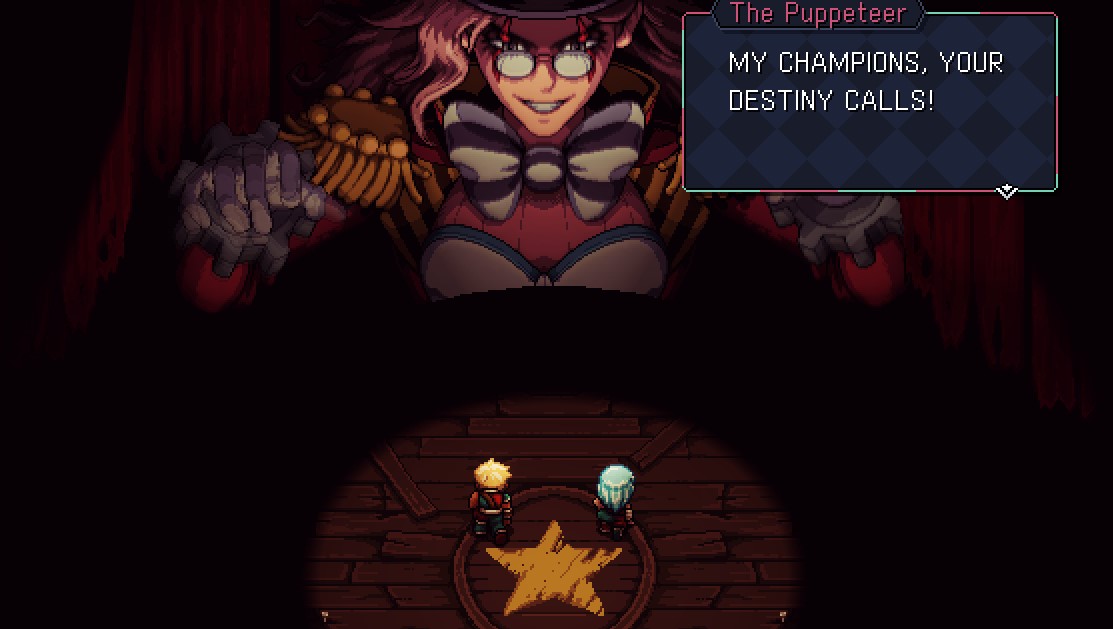
Wheels is the game that actually exists as a minigame, with figurines, champions and a dedicated achievement for beating the Watchmaker. The Throes of the Watchmaker DLC adds three more Wheel Champions in Horloge, behind a Warlock figurine you assemble by fishing four kinds of Goodie Bags out of ponds.
The Horloge carnival runs a Test of Balance, a Test of Strength and a Test of Accuracy, and topping all three is its own achievement. Still no rock paper scissors.
So if you arrived looking for a minigame, there isn’t one. If you arrived because combat felt like rock paper scissors and you wanted to know why, the seven amendments above are the answer.
FAQ
Is there a rock paper scissors minigame in Sea of Stars?
No. The game’s minigames are Wheels, the Mr. Chest chest game and the three Horloge carnival tests. The rock-paper-scissors comparison describes the Lock combat system instead.
What are the six damage types?
Sword and Blunt are physical; Sun, Moon, Venom and Arcane are magic.
What happens when you break all the locks on a spell?
The spell is cancelled entirely and you gain a significant amount of Combo Points. The same spell then returns with its timer reduced by at least one the next time that enemy casts it.
How do you break two locks with one attack?
Boosted regular attacks add a magic type to a physical one – Zale’s covers Sword and Sun. Multi-hit attacks like Valere’s Moonerang break several of the same type, and Seraï’s Disorient counts as Venom and Blunt together.
Does the spell timer run in real time?
No. It drops by one each time a party member takes a turn, so thinking costs you nothing and acting costs you the clock.
How do you know an enemy’s weaknesses?
Equip the Eye of Yomara trinket, which lists whether each enemy is vulnerable, neutral, resistant or immune to every damage type.
Is Mr. Chest winnable with strategy?
Not really. It is random, so save before playing and reload if you lose your money. Five grand prizes earn a Rainbow Conch.
Six Hands and a Sentence to Finish
What I find genuinely clever about this system is that it took the simplest competitive game humans have and removed the competition from it. Rock paper scissors is about guessing. Sea of Stars keeps the hands, shows you your opponent’s throw, gives you more hands than they have, lets you throw several at once, puts the clock under your own control, and then hands you an item that lists every weakness. By any reasonable reading, it has made the game trivially easy.
It hasn’t, because the difficulty moved somewhere else. It now lives in whether your three available characters, in a forced rotation, holding the Live Mana and Combo Points you banked two turns ago, can produce a specific four-symbol sequence inside three actions – while another enemy’s timer runs down inside the same window.
That is a scheduling problem dressed as a children’s game, and it is why the fights keep working for forty hours.
Learn the six hands. Bank Live Mana on purpose. And think twice before you cancel a spell, because the game remembers that you did.
Bookmark this post, since the Dawn of Equinox and Watchmaker updates both changed how Combo Points behave and we revise this page rather than filing a fresh one. And if creative or commercial collaboration brought you here, write to the YaninaGames team directly – we show our hand before you throw.