
Nivalis Nights Review: Order the Atmosphere, Send Back the Framerate
You inherit a noodle bar and somebody else’s debt. That’s the opening. It’s a wonderful premise, and I want to say upfront that the city this game puts around it is one of the best-looking places I’ve visited in years. Neon smearing across wet pavement, rain that behaves like weather instead of a filter, districts you reach by taxi and train and boat. ION LANDS have been building Nivalis since Cloudpunk, and it shows.
Then you walk into a street with forty NPCs in it and your framerate falls out of the sky.
That tension is the whole story of this launch. The game came out on September 29 on PC, published by 505 Games, and in the week since it has been simultaneously praised as one of the year’s most atmospheric games and review-bombed over optimization. There’s an apology from the publisher. There are two patches already. There’s a Steam score sitting at Mostly Positive, which is the most accurate summary anyone has produced.
So let’s serve this as the game would – course by course – and settle the bill at the end.
What’s Actually on the Table?
| Detail | Status |
|---|---|
| Developer | ION LANDS |
| Publisher | 505 Games |
| Release | September 29, 2026 |
| Platform | PC |
| Genre | Cyberpunk life sim and business management |
| Steam rating | Mostly Positive, around 74% across roughly 2,800 reviews |
| Critic scores so far | 7/10 AIPT, 70/100 NoobFeed, with the Metacritic average still pending |
| Patches since launch | Two, on October 1 and October 2 |
| Hardware target | 1440p/60 on high with an RTX 4070 or RX 7800 XT |
| Upscaling at launch | None |
That last row explains more than people realise. A 2026 release with no DLSS, no FSR, nothing – in a game whose main performance problem is crowd density. There’s no software escape hatch, so every frame you lose has to be won back in the engine.
First Course: The City Is the Best Thing Here
Let’s be generous where generosity is earned, because this part is genuinely special.
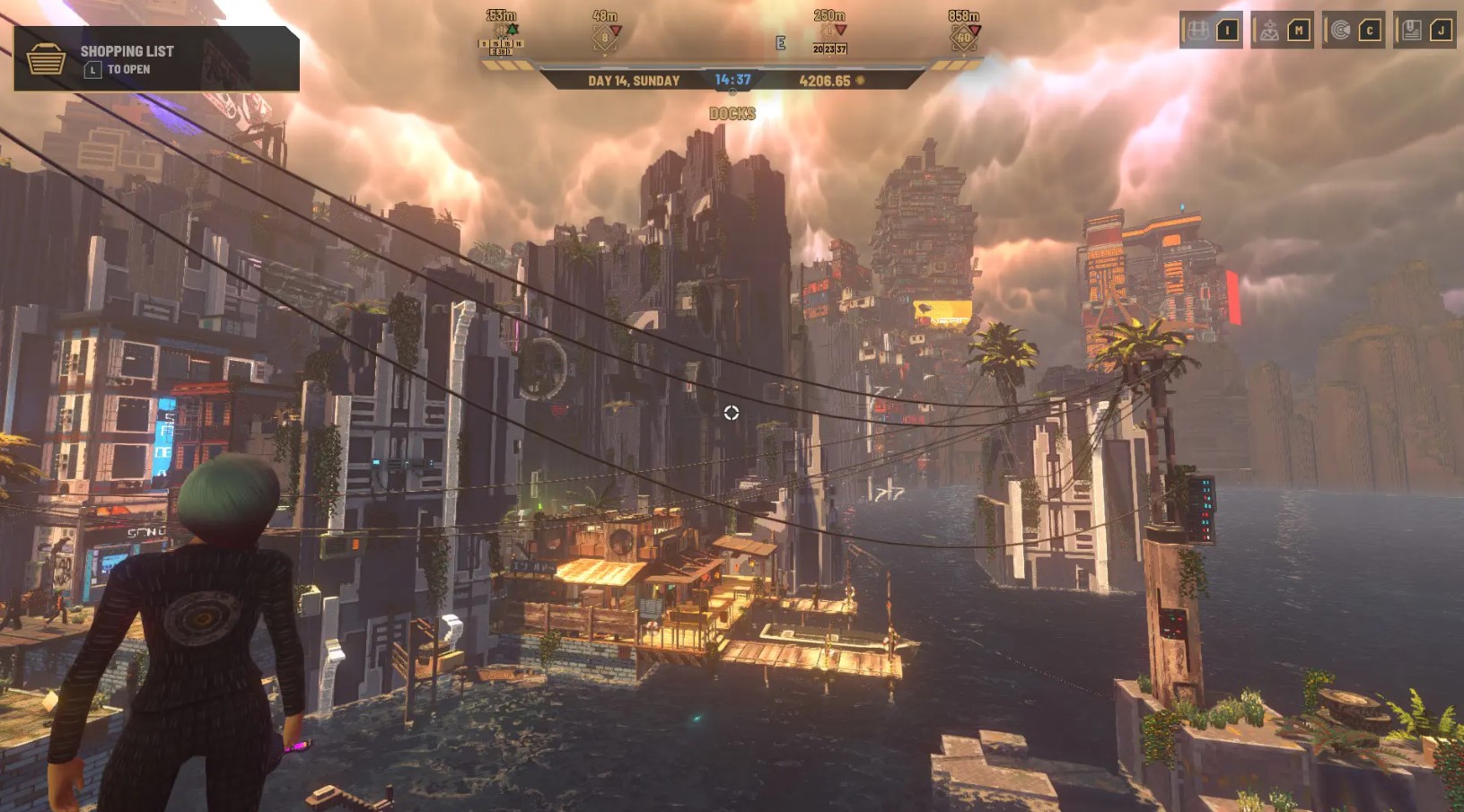
Nivalis is a sinking city rendered in a voxel-inspired style that sounds like it should look cheap and instead looks extraordinary after dark. Reviewers kept reaching for the same image – neon signs smearing across puddles – because that’s precisely what it does, and the dynamic weather and day-night cycle make the same street feel different at 3am than it did at noon.
More importantly, it feels inhabited rather than decorated. Over a hundred NPCs, voiced, with their own business. Districts with distinct characters, reachable by multiple transport systems. One user review called it the most immersive urban environment ever designed, which is overheated but you can see what prompted it.
The things that make it work:
- Verticality and layering, so the city reads as a place with a history rather than a map.
- Weather with consequences rather than ambient rain on a loop.
- Transport variety – taxi, train and boat all feel like parts of a functioning city.
- Voiced NPCs in volume, which is expensive and rare in a game this size.
- Recipes found through exploration, tying the wandering directly to the business loop.
If you played Cloudpunk and wanted to get out of the car and live down there, this delivers that specific fantasy better than anything else has.
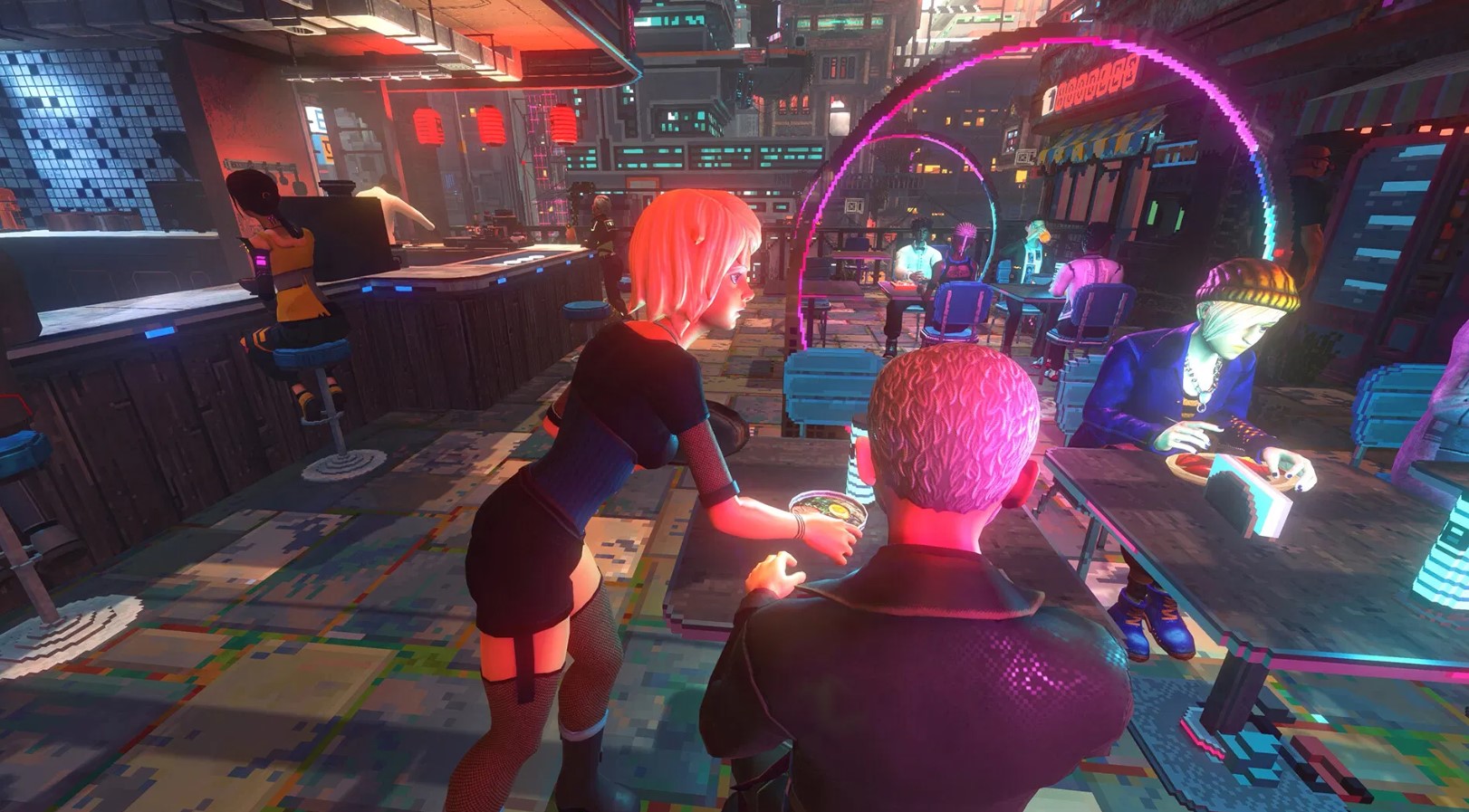
Nivalis Nights Review of the Main Course: Running the Noodle Bar
The restaurant management is the deepest system in the game, and it’s the reason to be here.
You start small – a food stall, a noodle stand – and grow toward bars, restaurants and nightclubs. Between you and that empire sits the inherited debt, which gives the whole economy a pulse. Ingredient sourcing, staff hiring, menu design, daily operations, all interlocking.
What impressed me is how small decisions propagate. NoobFeed’s reviewer put it well, noting that even minor choices ripple through and change how smoothly the restaurant runs day to day. Hire wrong and your service suffers three days later. Stock badly and your margins vanish.
That’s proper business-sim design, and when it’s humming it’s genuinely absorbing. One critic observed there’s no way to switch your brain off while playing, which in this genre is a compliment.
It isn’t flawless. The most-reported balance problem is managers overspending on inventory restocking, which can stall progression entirely. AIPT’s reviewer ended up stealing ingredients from competitors to get around it – an unintended solution to a tuning issue, and a funny image, but not a sign of a balanced economy.
Side Dish: The Murder Mystery Works
I didn’t expect the narrative to be the thing I kept playing for. A serial killer is hunting debt-orphans in Nivalis, and your inherited debt makes you exactly the sort of person who draws attention. Meanwhile CorpSec runs the city with the authoritarian cheer you’d expect, and the game asks you repeatedly whether you’d rather climb the corporate ladder or resist it.
It’s not subtle. Cyberpunk rarely is. But it gives the business sim a reason to exist beyond spreadsheet pleasure, and the moral framing lands because your restaurant’s success is literally built on the system you’re being asked to judge.
Around the main thread sit fishing, farming, chess tournaments and relationship-building with the city’s residents. Side content that would feel like padding in a weaker setting feels like texture here.
Undercooked: The Life Sim Half
Here’s where the menu overpromises. It’s billed as a life sim, and that framing sets expectations it doesn’t meet. Your apartment is primarily a decoration space – you furnish it, you look at it, and then you leave. There are no basic needs to manage. You don’t eat there. You don’t sleep there in any mechanically meaningful way.
For a game about running restaurants, your own character never getting hungry is a strange hole.
NoobFeed landed on the right reading: treat this as a business simulator with narrative attached rather than a complete cyberpunk life RPG, and your expectations survive contact. Go in expecting Stardew-with-neon and you’ll spend the first five hours looking for systems that aren’t there.
Too Many Dishes at Once
The structural criticism is consistent across every review I read, and it’s the fairest one: the game is doing too much.
AIPT’s reviewer had 45 to 50 active quests by day 30. Not completed – active. The compass bar fills with overlapping markers, the side-scrolling map doesn’t help, and the result is a creeping anxiety in a game that has no time limit at all. Their phrasing was that a sense of urgency took over as though they were on a deadline that didn’t exist.
That’s a design problem rather than a content problem. The quests themselves are fine. There are simply too many handed out too fast, with navigation tools too weak to organise them.
- Quest clutter arrives faster than you can clear it, creating false pressure.
- The map is the weakest interface in the game – a detailed one would fix much of this.
- Controller support creates friction, particularly in inventory navigation.
- Markers crowd both screen and map, so prioritising becomes guesswork.
- Save-file loss has been reported, which is the bug that actually hurts.
That last bullet is the one to watch before you commit forty hours. Back up your saves.
Sent Back to the Kitchen: The Performance Story
Now the part everybody’s talking about, and it deserves telling in order because the developer’s handling of it became its own story.
The problem: severe framerate drops in crowded areas, falling to around 30fps even on strong hardware. One Steam reviewer running an RTX 4090 and an i9-12900KS – while still recommending the game – described performance as miserable. Players widely reported it running worse than Cyberpunk 2077 with ray tracing on once enough NPCs were on screen.
The misstep: 505 Games initially responded with what players read as a copy-paste reply, acknowledging framerate can vary in areas with lots of NPCs and suggesting a restart or a change to power settings. For a game asking for an RTX 4070 to hit 1440p60, telling 4090 owners to reboot went down exactly as you’d imagine.
The correction, to their credit: the publisher apologised properly, saying they completely understood how the restart advice came across as dismissive. Representatives called performance a huge pain point for the team and admitted it isn’t where it needs to be right now. That’s a more honest statement than most studios manage.
The patches: October 1 brought performance improvements. October 2 added a Lighting Details slider letting you limit how many active lights a scene renders – a smart, targeted fix, since in a city built out of neon the lighting count is the obvious culprit.
What’s still open: no deadline for the remaining optimization work, and no confirmation that upscaling is coming. Those are the two things that would change the picture most.
| Review | Score | Core Complaint |
|---|---|---|
| AIPT | 7/10 | Quest overload, navigation, economy balance |
| NoobFeed | 70/100 | Shallow life sim, performance, interface friction |
| Rogue | No score | Systems not yet integrated, needs more time |
| Steam players | ~74% positive | Performance above everything else |
Read that table and a consensus emerges that’s rare in its clarity. Nobody thinks the game is bad. Everybody thinks it shipped early.
Nivalis Nights Review Verdict: The Bill
Buy it now if: you’re a business-sim player first, you have hardware comfortably above the recommended spec, and atmosphere matters more to you than frame consistency. The restaurant loop is genuinely good and the city is a place worth spending time in. Two patches in a week also suggests a team that’s actually working.
Wait if: you’re on hardware near the recommended line, you play with a controller, or you wanted the life-sim half of the pitch. None of those three things are in a good state yet, and all three are the kind of problem patches can plausibly fix.
Skip it if: you need polish at launch as a matter of principle. This one visibly needed another few months, and multiple reviewers said as much – one suggested it would have been better served arriving as Early Access, which is hard to argue with.
Where I land personally: this is the most interesting cyberpunk game of the year and it’s not yet the best version of itself. That’s a frustrating sentence to write about something with this much craft in it, because the gap between what Nivalis Nights is and what it obviously wants to be is mostly technical rather than creative.
Give it until the new year. If upscaling arrives and the crowd performance gets sorted, I suspect we’ll be calling this one underrated by spring.
FAQ
When did Nivalis Nights come out?
September 29, 2026, on PC, developed by ION LANDS and published by 505 Games.
Is it connected to Cloudpunk?
It’s from the same studio and set in the same city of Nivalis, so the setting will be instantly familiar.
What’s the Metacritic score?
Still pending as of now – not enough counted critic reviews. Individual scores have landed around 7/10.
How bad is the performance really?
Drops to roughly 30fps in busy areas, including on high-end hardware. Two patches have landed and the lighting slider helps.
Does it have DLSS or FSR?
Not at launch, and the developer hasn’t confirmed whether upscaling is coming.
Is it a life sim or a business sim?
Primarily a business sim. The life-sim elements are thin – your apartment is decorative and there are no survival needs.
Should I wait for patches?
If your hardware is near the recommended spec, yes. If you’re comfortably above it, the game underneath is worth playing now.
A Kitchen With More Ambition Than Burners
Everything on the Nivalis Nights menu sounds good. A deep restaurant sim, a murder mystery about debt and the people it orphans, a hundred voiced residents, fishing and farming and chess, one of the most convincing cities in the genre. Individually, those are all real and several are excellent.
Served together, on launch-week hardware, the kitchen can’t keep up. Forty quests arrive at once. The framerate buckles when the dining room fills. The apartment you decorated turns out to be scenery.
But a week in there have already been two patches and a straight apology, which is more than plenty of bigger studios offer. The bones are good. The city is better than good.
Order it when the kitchen’s caught up. Or order it now and tip generously, because the cooking is worth encouraging.
If this saved you from a refund or talked you into a game you’ll love in three months, pass it along on X, Reddit or wherever your sim-game friends gather – small writing teams run on word of mouth and nothing else. Bookmark it too, because this is a review with an expiry date: patches are landing weekly and we’ll be revising it rather than filing a fresh one. And if creative or commercial collaboration brought you here, write to the Lizet Manski team directly – our kitchen is always open.