
Obsidian Ring of the Zodiac in Diablo 3: Why It Still Slaps
Ask any longtime Diablo player about the rings that quietly carried whole builds, and one name keeps coming up. It’s not flashy. It doesn’t light up your screen. But it turned clunky, cooldown-heavy heroes into machines that never stop firing their big buttons. That ring is the Obsidian Ring of the Zodiac. And honestly? It’s one of those items where the description sounds boring until you actually feel it work.
Here’s the short version. The ring’s headline power reads like this: reduce the remaining cooldown of one of your skills by 1 second whenever you hit with a resource-spending attack.
Sounds small, right? One second. Big deal.
But think about how Diablo 3 combat works. You’re spamming a spender – Whirlwind, Spectral Blade, Hammer of the Ancients, whatever your build leans on – many times per second. Each of those hits can shave a second off a recharging skill. So your 30-second ultimate? It’s suddenly ready in a fraction of that time. That’s the trick. The ring turns your everyday attacks into a cooldown blender.
It works for any class, by the way. This isn’t a Barbarian-only or Wizard-only deal. Whoever finds it, equips it.
The thing is, the proc has rules. And those rules matter more than the casual player realizes.
Let me walk you through the whole thing – what it does, how to grab one, how to squeeze every drop of value out of it, and what filled the gap once Diablo 4 rolled around. Grab a snack. There’s a lot of good stuff here.
What Does the Obsidian Ring of Zodiac in Diablo 3 Actually Do?
Let’s get specific, because the fine print is where builds live or die.
The effect triggers once per cast, or once per tick for channeled skills, for any damaging attack that costs a resource. When it fires, it randomly knocks one second off one currently recharging skill. Not all of them. One, picked at random from whatever’s on cooldown. So if you’ve got three skills recharging, the ring spreads its love around instead of dumping everything onto your ultimate.
That randomness is why some builds adore it and others shrug. If your whole game plan rests on a single long-cooldown skill, the ring feels incredible – almost every proc lands where you want it. Stack a bunch of cooldowns and the value gets diluted.
Now the gotcha that catches people out. Skills that don’t actually cost a resource won’t trigger the effect. If a rune, a pylon, or another item removes the cost of your attack, the ring sees a free skill and does nothing. Classic example from the community: pair certain Crusader items that strip the Wrath cost off a skill, and suddenly your Zodiac proc goes silent. Free isn’t free, in this case.
One more class-specific quirk worth knowing. For Demon Hunters, only Hatred spending counts. Discipline spenders – your defensive, evasive stuff – won’t trigger a thing. So a Demon Hunter chasing Zodiac value needs to keep those Hatred attacks flowing.
| Property | What It Does | Rough Range |
|---|---|---|
| Cooldown Reduction | Lowers all skill cooldowns | 5 – 8% |
| Attack Speed | Faster attacks (more procs!) | 5 – 7% |
| Critical Hit Chance | More crits | 4.5 – 6% |
| Resource Cost Reduction | Cheaper skills | 5 – 8% |
| Unique Power | -1 sec on a recharging skill per resource-spending hit | Fixed |
| Ignores Durability Loss | Gear never breaks | Secondary |
Notice something nice there? The ring rolls Attack Speed as a guaranteed stat. More attack speed means more hits per second, which means more procs. The item basically feeds itself. That’s clever design, and it’s a big reason the ring punches above its weight.
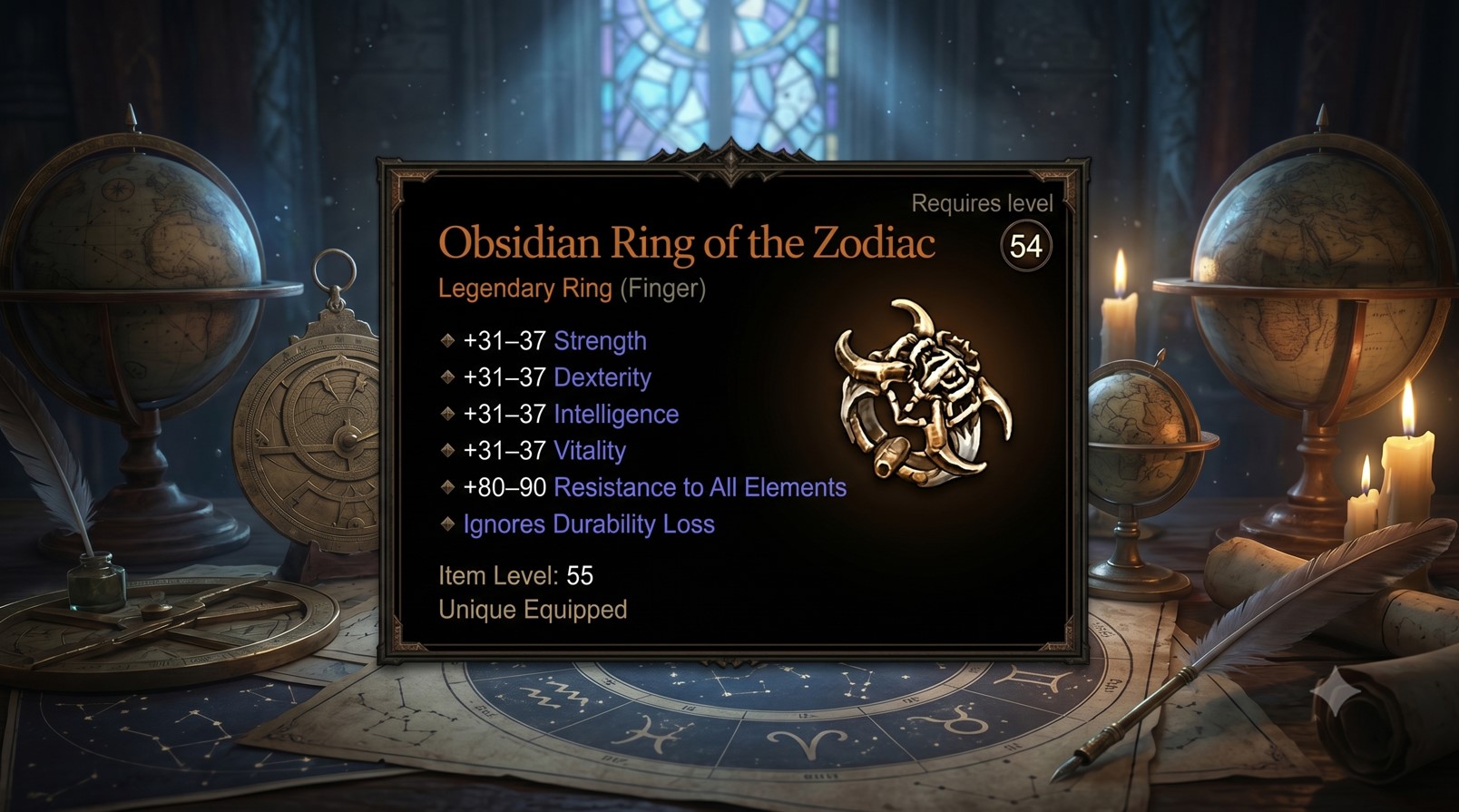
The Lore Tucked Inside the Name
Quick tangent, because this one’s fun and most players skip right past it.
The Obsidian Ring of the Zodiac isn’t a random name some designer pulled out of a hat. It’s a love letter to Diablo 1.
Back in the original game, the most drooled-over ring you could find wasn’t a unique at all. It was a plain magic ring that happened to roll two perfect affixes together: “obsidian,” which gave a chunky bonus to all resistances, and “of the zodiac,” which boosted all your attributes. Players called it the “ObZod.” Finding one was a genuine event.
So when Diablo 3 launched, the developers built a tribute. Early previews back in 2011 actually gave the ring stats that had nothing to do with the original – and fans, bless them, made a lot of noise about it. The devs listened and reworked it to honor the old all-resist, all-stats combo. Later patches changed the numbers again, eventually landing on the cooldown power we know today.
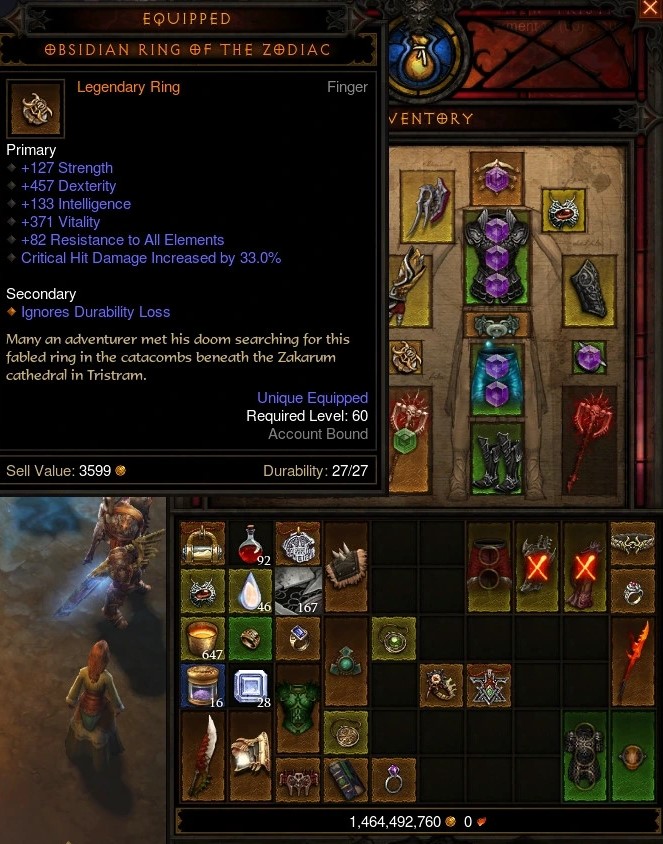
The in-game flavor text leans into it too, with a line about adventurers meeting their doom hunting the fabled ring beneath the old Zakarum cathedral in Tristram. It’s a small thing. But it ties three games together with one piece of jewelry, and I love that.
Anyway – back to the part you actually came for.
How to Get Your Hands on One?
Good news first. This ring drops for everyone now. There was a stretch where it was a season-only item after its big rework, but those days are long gone. Hit character level 50 and it’s in the loot pool.
The bad news? It’s still a needle in a haystack if you just play normally and pray. Diablo 3’s loot tables are deep, and “wait for it to drop” is not a plan. It’s a hope.
How to Get the Obsidian Ring of Zodiac in Diablo 3 Without Losing Your Mind
You’ve got a few reliable routes, and smart farmers use all of them:
- Gamble at Kadala. Spend your Blood Shards on rings. Kadala can cough up legendary rings, and the Zodiac is in that pool. It’s pure RNG, but you’re rolling the dice on demand instead of waiting around. Stockpile shards from rifts and bounties, then dump them all in one big session.
- Use Kanai’s Cube. This is the smart-money play. The cube’s recipe for upgrading a rare item to legendary lets you target a specific item slot. Feed it rare rings and reagents, and every conversion is a fresh shot at a legendary ring – Zodiac included. Hoard your Death’s Breath and Veiled Crystals for this.
- Farm rifts. Nephalem Rifts and Greater Rifts are loot piñatas. The more you run, the more legendaries you see, and the more Blood Shards and crafting mats you bank for the two methods above. It all loops back together.
Here’s the rhythm most players settle into: run rifts to build up resources, then blow them all at Kadala and the cube in focused bursts. You’re not waiting for luck. You’re manufacturing chances.
And once you’ve got a copy? You’re not done. You’ll want an Ancient or Primal Ancient version for the bigger stat rolls, plus a clean socket added through enchanting at the Mystic. Don’t sweat the ring’s Ancient status for the socket itself – that’s an enchant either way. Focus on getting the trifecta stats (crit chance, crit damage, attack speed) and your mainstat to line up.
It’s a grind. But it’s the satisfying kind, where every run nudges you closer.
How to Actually Use It (So the Proc Doesn’t Go to Waste)?
Owning the ring and using it well are two different sports.
The whole point is feeding the proc. You want fast, cheap, resource-spending attacks landing constantly, so the cooldown reduction never stops ticking. Builds that sit around between big hits waste the ring. Builds that machine-gun their spenders milk it dry.
This is why the Zodiac historically pairs beautifully with skills that have long, painful cooldowns – the kind you wish you could press more often.
The community favorites over the years have been the heavy hitters:
- Wizard Archon builds, where keeping that powered-up form online is the entire fantasy.
- Barbarian Wrath of the Berserker setups that want their war cry up permanently.
- Earthquake Barbarians stacking those rumbling AoEs back to back.
- Crusader Akarat’s Champion builds chasing near-constant uptime on their big buff.
See the pattern? Every one of these has a signature long-cooldown skill that defines the build. The ring takes “available every 30 seconds” and turns it into “basically always.” That’s a different game.
Quick word of caution, though, since I mentioned it earlier and it bites people constantly. If your build uses items or runes that remove a skill’s resource cost, double-check that you’re not accidentally killing the proc. The ring needs you to actually spend something. A free cast is a wasted cast, as far as the Zodiac’s concerned. Test it on a dummy, watch your cooldowns, and confirm they’re dropping when you attack.
| Build Type | Zodiac Value | Why |
|---|---|---|
| Single long-cooldown core (Archon, WotB) | Excellent | Procs almost always land on the skill you care about |
| Channeled spenders | Strong | Each tick counts as a hit, so procs flow fast |
| Multiple short cooldowns | Moderate | Random target spreads value thin |
| Cost-free / pylon-fueled spam | Poor | No resource spent means no proc |
If your build lives in that top row, the Zodiac isn’t optional. It’s the engine.
So, What’s the Diablo 4 Analog?
Right, the question everyone migrating from Diablo 3 asks. You loved the cooldown blender. Where is it in Diablo 4?
Straight answer: there isn’t a one-to-one port. Diablo 4 doesn’t have a single ring that says “minus one second per hit.” Blizzard rebuilt the entire cooldown system, so the Zodiac’s exact mechanics don’t really exist anymore.
But the spirit of it – keeping your big skills firing far more often than the base cooldown should allow – is alive and well. It’s just spread across a bunch of different tools.
In Diablo 4, cooldown reduction is a percentage stat. It’s capped at 75%, and the sources stack multiplicatively rather than just adding up. That last bit trips people up. Two sources of 30% reduction don’t give you 60%. They combine differently, with diminishing returns the higher you climb. The cap exists on purpose – Blizzard didn’t want everyone hitting every button on permanent zero cooldown, because that flattens the whole combat puzzle.
Your cooldown reduction in Diablo 4 comes from a mix of places:
- Legendary Aspects that you imprint onto gear, several of which slash cooldowns when you meet a condition – hitting enemies, casting a certain skill, killing something.
- Unique items with built-in cooldown effects baked into their power.
- Paragon glyphs and passives that quietly stack reduction in the background.
- Flat cooldown reduction affixes that roll on rings, amulets, and other slots.
The closest in feel are the conditional aspects – the ones that reduce a cooldown when you do something in combat, rather than just passively. A few examples that have floated around the community as build cornerstones: aspects that cut a shout’s cooldown for every nearby enemy, amulets where casting one skill dramatically slashes another skill’s cooldown, and rings that reduce ultimate cooldowns.
The exact names and numbers shift season to season – Diablo 4 patches constantly – so always check current values before you build around one. But the design DNA traces straight back to that little ring in Diablo 3.
| Aspect | Diablo 3 (Obsidian Ring of the Zodiac) | Diablo 4 (CDR system) |
|---|---|---|
| Core mechanic | Flat -1 sec per resource-spending hit | Percentage reduction, condition-based aspects |
| Source | One specific legendary ring | Spread across aspects, uniques, paragon, affixes |
| Cap | No hard cap on the proc | 75% cooldown reduction cap |
| How it stacks | Just hit stuff more | Multiplicative, with diminishing returns |
| Build feel | Spam spenders, watch cooldowns melt | Hit conditions, manage a CDR budget |
The big philosophical shift? Diablo 3 lets you brute-force your cooldowns through raw attack speed and one ring. Diablo 4 wants you to think about it – to build toward reduction deliberately and respect the ceiling. Neither’s wrong. They’re just different vibes.
Which Approach Felt Better?
Pure opinion territory here, so take it with salt.
There’s something gleefully dumb about the Diablo 3 version. You slap on the ring, crank your attack speed, and your screen becomes a non-stop fireworks show because your big skills are always ready. It’s not subtle. It’s not balanced. It’s a power fantasy turned up to eleven, and that’s exactly why people remember it so fondly.
Diablo 4’s system is more disciplined. You make real choices. You weigh a cooldown aspect against a damage aspect. You bump into that 75% cap and have to decide whether the next point of reduction is worth the slot. It’s a tighter puzzle, and for a lot of players that’s more rewarding over the long haul.
Me? I miss the chaos a little. But I respect the craft of the newer one. And the fact that the Zodiac’s idea survived the jump between games – just dressed in new clothes – says the original design was onto something real.
Funny how one unassuming ring left fingerprints all over a sequel.
FAQ
Does the Obsidian Ring of the Zodiac still drop in Diablo 3?
Yep. It used to be season-only after its rework, but it now drops for all characters once you hit level 50. It’s a standard part of the legendary loot pool.
Can any class use it?
Any class can find and equip it. The catch is build fit – it shines brightest on heroes built around one big long-cooldown skill, and Demon Hunters only proc it from Hatred spending, not Discipline.
What’s the fastest way to farm it?
Combine three things: gamble rings at Kadala with Blood Shards, target legendary rings through Kanai’s Cube upgrades, and run rifts to keep your resources topped up. Don’t rely on random drops alone.
Why isn’t my cooldown going down even with the ring on?
Most likely your attacks aren’t actually spending a resource. If a rune, pylon, or item makes a skill cost-free, the ring won’t trigger. Make sure you’re hitting with a genuine resource-spending attack.
Does attack speed make the ring better?
Absolutely. The ring rolls Attack Speed as a built-in stat for a reason. More attacks per second means more procs per second, so stacking attack speed directly boosts how fast your cooldowns melt.
Is there an Obsidian Ring of the Zodiac in Diablo 4?
Not by name, and not as a direct copy. Diablo 4 handles cooldown reduction through a percentage system capped at 75%, fed by aspects, uniques, and paragon. The Zodiac’s idea lives on in condition-based cooldown aspects.
What Diablo 4 items come closest to that old feeling?
Look for legendary aspects and uniques that reduce a skill’s cooldown when you act in combat – hitting enemies, casting a paired skill, or landing kills. Those conditional effects capture the spirit, even if the exact mechanic is gone. Just verify current numbers, since they change with patches.
Final Thoughts
The Obsidian Ring of the Zodiac is proof that a “boring” stat can become legendary in the right hands. One second per hit. That’s the whole pitch. And it reshaped how an entire generation of Diablo 3 builds played.
If you’re still grinding Sanctuary in Diablo 3, go chase one – target it through Kadala and the cube, roll for that Ancient version, and pair it with a build that actually feeds the proc. You’ll feel the difference the moment your ultimate comes back early.
And if you’ve moved on to Diablo 4, keep an eye out for those cooldown aspects. The ring may be gone, but its big idea? Still very much in the game. Some designs are just too good to leave behind.
P.S. Help propel our vision forward by sharing this post across your social media channels and saving it to your bookmarks! If you have an exciting project in mind, do not hesitate to write to the Lizet Manski team directly to explore potential creative and commercial collaborations. We truly value your online support and are always eager to partner with visionary minds to bring fresh ideas to life.