
Persona 5 Futaba: Meet the Phantom Thieves’ Oracle
You know what makes a Persona team click? It’s not just the front line trading hits with Shadows. It’s the voice in your ear telling you which enemy is about to fold like wet cardboard. That’s where Persona 5 Futaba Sakura comes in. She doesn’t swing a weapon or throw a single Agi spell at the bad guys, yet somehow she’s the reason your boss fights feel winnable.
Futaba Sakura, code name Oracle, sits in the back of the group’s strange little bus-turned-cat and basically runs the whole operation like a one-girl command center. She scans, she buffs, she heals, and she occasionally knocks every enemy flat on their backs before the fight even starts. If you’ve ever wondered why veterans treat her social link as a must-finish, this guide will walk you through all of it – her story, her skills, how to max her out, and whether the romance route is worth your precious in-game evenings.
Who Is Futaba Sakura, Really?
Here’s the thing. When you first hear about Futaba, she’s not even a person you can see. She’s a name on a screen. A mysterious hacker called Alibaba who keeps messaging you with threats and demands, all tangled up in the Medjed plotline that nearly tanks the Phantom Thieves’ reputation.
Then the curtain drops. Alibaba turns out to be a teenage girl living upstairs in the same café you call home. Futaba is the foster daughter of Sojiro Sakura, the gruff coffee-and-curry guy who runs Café Leblanc and reluctantly took you in. She barely leaves her room. She doesn’t go to school. She’s a shut-in – a hikikomori – locked away after the death of her mother left her drowning in guilt and grief.
Her mom was Wakaba Isshiki, a brilliant cognitive science researcher whose work is, weirdly enough, tied to the very Metaverse you keep diving into. Wakaba died under awful circumstances, and Futaba was made to believe she caused it. That kind of weight on a kid? It’s no wonder she shut the door on the world. Relatives blamed her. The lie buried itself in her head. And she just… stopped.
What gets me about her writing is how real the anxiety feels. She’s not a quirky comic-relief nerd, even though she has plenty of gremlin energy once she warms up. Underneath the gaming references and the goofy memes, there’s a girl trying to claw her way back to being okay. Honestly, that mix is why she lands so hard with players.
A few quick facts to anchor you before we go deeper:
- Arcana: The Hermit, which suits a self-isolating loner perfectly.
- Code name: Oracle, with goggles standing in for her Phantom Thief mask.
- Persona: Necronomicon, a UFO-shaped contraption with a gargoyle riding on top.
- Birthday: February 19, and yes, that matters for gift-giving timing.
- English voice: Erica Lindbeck, who nails both the awkward mumbling and the chaotic confidence.
How Does Persona 5 Futaba Join the Phantom Thieves?
So here’s what happened. After the Medjed mess forces the team’s hand, Futaba does something no other character in the game does – she asks the Phantom Thieves to steal her own heart. She wants them to break into her Palace and fix whatever’s broken inside her, because she can’t do it alone.
Her Palace is a sand-swept Egyptian tomb, a pyramid stuffed with hieroglyphs that tell the story of her mother’s death the way Futaba’s distorted memory recorded it. It’s one of the most emotionally loaded dungeons in the whole game. You’re not stealing treasure from some corrupt adult here. You’re untangling a kid’s trauma, room by room.
The boss fight is a gut-punch – a cognitive version of Wakaba, twisted into a monster by Futaba’s grief. And during that battle, Futaba does something that changes everything. She fights back. She rejects the lie. And she awakens to her Persona, Necronomicon, breaking through the chains she’d wrapped around herself.
She doesn’t officially join the crew right then, though. That comes a little later, during a beach trip where she finally steps outside, sand between her toes, and tells the gang she’s in. Codename Oracle, locked and loaded. From that point on, the back row of every battle gets a whole lot louder – in the best way.
What Oracle Actually Does in Battle?
Let’s be straight about her role, because it trips up new players. Futaba is a navigator. She does not take a slot in your active party of four, and she can’t be targeted or knocked out. She just… helps. Constantly. From the moment she joins, she’s chiming in with analysis the second you scan an enemy, flagging weaknesses, status ailments, and whether something’s about to use a nasty move.
But the analysis is only the appetizer. The real value comes from her support skills, which fire off at random during fights and scale up as you rank her confidant. Think of her like a backup singer who occasionally grabs the mic and saves the whole song.
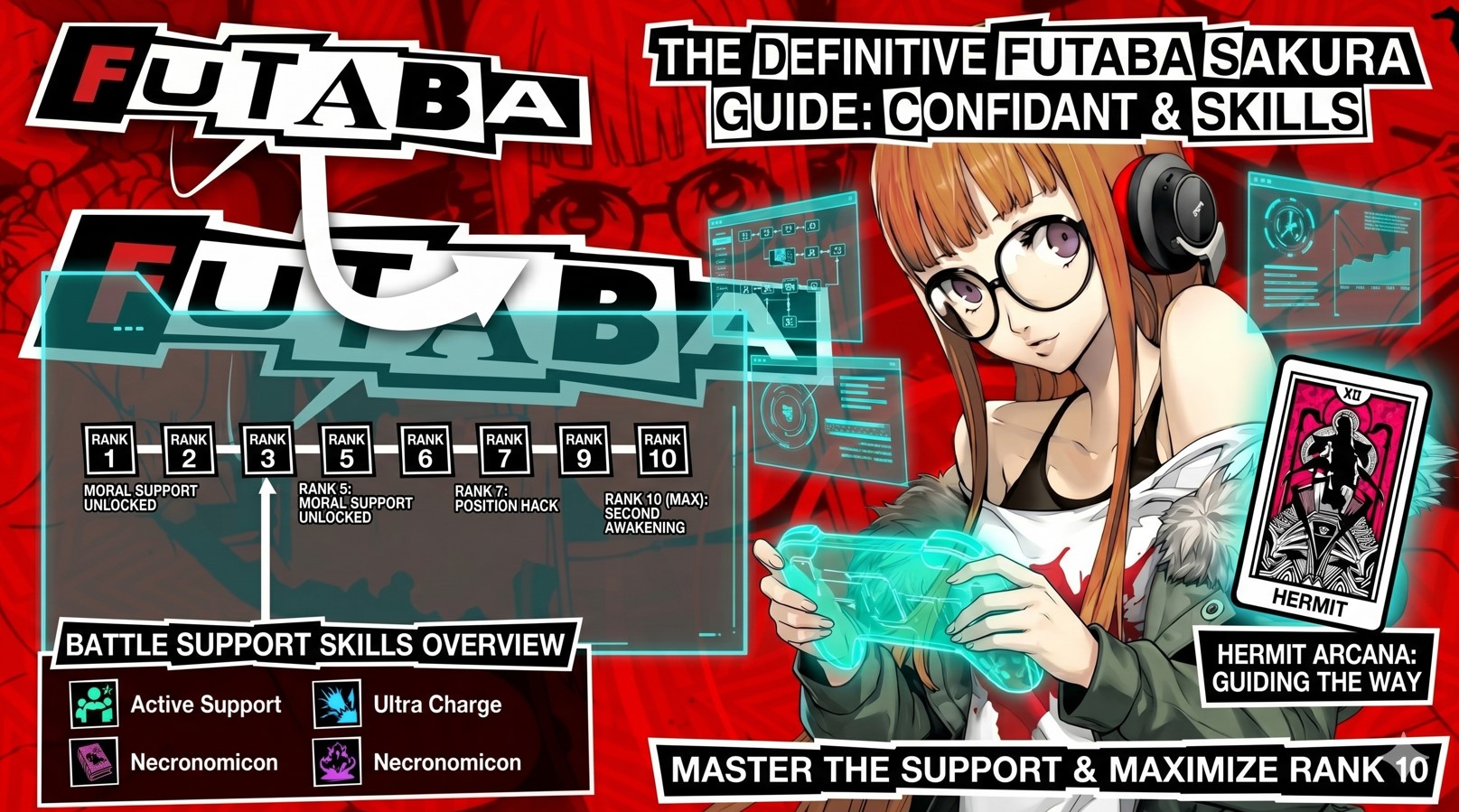
Her flagship ability is Moral Support, which has a chance each turn to either heal the whole party or slap a Kaja buff on everyone – boosting attack, defense, or agility. It’s random, sure, but when it triggers at the right moment during a grueling boss, it feels like the game just handed you a lifeline.
As she ranks up, that random pool gets stronger and stranger.
| Confidant Rank | Ability | What It Does |
|---|---|---|
| Rank 1 | Moral Support | Random chance to heal the party or cast a Kaja buff mid-battle |
| Rank 2 | Mementos Scan | Reveals the layout and goodies on a Mementos floor |
| Rank 4 | Position Hack | Chance to knock down all enemies at battle start for a free Hold Up |
| Rank 6 | Active Support | Upgrades Moral Support to also recover SP or grant Charge and Concentrate |
| Rank 7 | Treasure Reboot | Sometimes respawns search objects after a fight so you can loot again |
| Rank 9 | Emergency Shift | Swaps in reserve members when two or more allies go down |
| Rank 10 | Fatal Guard | Chance to null an otherwise lethal hit against any party member |
Look at that Rank 10 ability for a second. Fatal Guard can quietly save a run from disaster. You’re one bad turn from a game over, the screen’s flashing red, and then Oracle just… cancels the killing blow. That’s not flashy. It’s better than flashy. It’s the safety net that lets you play aggressively.
Persona 5 Futaba Confidant Perks You’ll Actually Feel
There are a couple of standouts worth chasing fast. Position Hack is the one that’ll make you grin. At the start of a fight, there’s a chance Futaba just topples every enemy in the room, handing you an instant All-Out Attack or a free negotiation to recruit a new Persona. It doesn’t work on ambushes, but it can save you even when you’ve been surrounded, which is clutch.
And then there’s Active Support, the Rank 6 upgrade. Once Moral Support graduates into Active Support, it can dump SP back into your party or hand everyone Charge and Concentrate – meaning your next physical or magic attack hits roughly twice as hard. Pop that during a boss’s downtime and you can erase a huge chunk of its health bar in one coordinated burst.
Here’s why it matters: SP management is the real final boss of Persona 5. Running dry on magic points deep in a Palace is the fastest way to a frustrating retreat. Futaba’s SP recovery, plus the items and accessories you can stack on top, turns those long dungeon crawls from a slog into something you can actually push through in a single sitting. She’s the difference between “ugh, I have to leave and come back” and “let’s clear this whole floor right now.”
So while she never lands a hit herself, the cumulative effect of her kit is enormous. Veterans aren’t exaggerating when they call the navigator the backbone of the squad.
How to Max Her Hermit Confidant?
The Hermit confidant kicks off automatically on August 31, no hunting required. Once Futaba recovers enough to step outside, you’ll find her loitering near Leblanc during the day on certain weekdays, weather permitting. Rain ruins her plans, apparently. Relatable.
But there’s a catch. You can’t push past Rank 1 until you’ve hit Rank 4 of the Kindness social stat, the level called “Selfless.” So if you’re rushing her link, make sure you’ve been chipping away at Kindness beforehand – watch DVDs, read books, do part-time jobs, the usual social-stat grind. Show up to Futaba unprepared and you’ll stall out right at the gate, which is a feel-bad moment nobody enjoys.
A few pointers to keep the whole thing smooth:
- Carry a Hermit Arcana Persona whenever you hang out with her. Matching arcana gives you a bonus point on the right dialogue picks, which adds up over ten ranks.
- Reply to her texts quickly. Answering her hangout messages right away gives a 1.2x affinity bump, and those little nudges shave real time off the grind.
- Keep gifts in your back pocket to patch up any points you lose from a wrong answer – she’s into figures, games, and nerdy stuff, fitting for a self-described shut-in.
- Don’t panic over one bad choice. The point math is forgiving enough that a single miss won’t doom the whole link.
One quirk worth flagging: Futaba’s confidant has a story complication no other party member does. Midway through, you’ll get locked behind a Mementos request involving a kid named Kana-chan being mistreated. You have to complete that side mission before her link will continue. It ties neatly into her arc about protecting people who can’t protect themselves, so it’s not busywork – it’s character work.
When you finally max her out, the payoff is chunky. Necronomicon evolves into a new form, you unlock a powerful fusion in the Velvet Room, and you walk away with a keepsake that carries perks into New Game Plus.
| Stage | Persona Form | When It Happens |
|---|---|---|
| Starting form | Necronomicon | Awakened inside her Palace, the UFO with the gargoyle |
| Second Awakening | Prometheus | Maxing the Hermit confidant at Rank 10 |
| Third Awakening | Al Azif | Royal only, during the maxed-out Third Semester |
That second form, Prometheus, is named for the Titan who stole fire from the gods and handed it to humanity. Fitting for a girl whose whole journey is about reclaiming the truth and giving it to others. The third form, Al Azif, is the in-fiction Arabic name for the Necronomicon itself, looping the whole thing back to its Lovecraftian roots. Atlus loves a deep cut.
Should You Romance Her?
Okay, this one comes up a lot, and it’s a fair question with a slightly awkward answer. Yes, the game lets you romance Futaba. And yes, plenty of players adore her route because her growth is so genuine and her dynamic with the protagonist is sweet rather than dramatic.
That said, a lot of folks feel weird about it. Futaba reads as a younger-sibling figure for much of the story, and the protagonist effectively lives under the same roof as her foster dad. So the vibe can land somewhere between heartwarming and a little uncomfortable, depending on how you’ve been playing it. There’s no wrong call here – it’s your story.
Mechanically, romancing her doesn’t change her battle abilities, so don’t pick it expecting a power spike. What you do get are flavor rewards. On Christmas, she gives you Headphones, which let you earn extra confidant points with Hermit Personas in New Game Plus. On Valentine’s Day, she hands over Futaba’s Chocolate, an item that fully restores one ally’s SP. Useful, sentimental, totally optional.
My honest take? Romance her if the relationship clicks for you and the writing feels right. Skip it if it doesn’t sit well. The platonic version of her arc is just as rewarding, and her confidant abilities are identical either way.
Royal Extras and the Third Semester
If you’re playing Persona 5 Royal – and you probably should be, since it’s the definitive version – Futaba gets a pile of bonus content that the original game didn’t have.
The big one is the Jazz Jin jazz club in Kichijoji. Take Futaba there on a Sunday specifically (any other day does nothing, which is a sneaky trap) and she’ll learn extra support skills in sequence. These are the Support Plus skills, and they add debuff moves like Masukunda, Marakunda, and Matarunda to her random Moral Support pool. Translation: she’ll occasionally drop enemy accuracy, defense, or attack right when you need it. Stacking debuffs on a tough boss while your party stacks buffs is the classic Persona power move, and now Oracle helps with both sides of that equation.
Here’s the quick rundown of Royal-exclusive goodies tied to her:
- Support Plus 1, 2, and 3 from repeated Sunday trips to Jazz Jin, adding the three big debuff spells.
- The Third Semester arc, an entire new chunk of late-game story that recontextualizes the whole adventure.
- Al Azif, her third Persona evolution, which only appears if you max her confidant and reach that extra semester.
- A heartfelt mid-January scene where she comes to talk to the protagonist, a quiet moment that pays off her growth.
The Third Semester itself is some of the best writing in the franchise, and Futaba plays a real part in it. Without spoiling too much, the new content questions what the Phantom Thieves are actually fighting for, and watching Futaba – who started the game wanting nothing more than to disappear – choose to face a painful truth head-on hits different. That’s the whole point of her character, distilled.
Why Futaba Sticks With Players?
Let me be honest about something. There are flashier party members. Makoto’s got the motorcycle Persona. Yusuke’s got the dramatic painter energy. But Futaba is the one a ton of players name as their favorite, and it’s not just because she’s useful in a fight.
It’s the arc. A kid who blamed herself for her mom’s death, who couldn’t open a door without panicking, slowly learning to trust people again – that’s a story worth telling, and Persona 5 tells it with a surprising amount of care. The gaming references and the meme-speak are the sugar coating. Underneath is a genuine look at grief, anxiety, and the slow work of healing.
She’s stuck around outside the main game, too. Futaba shows up in Persona 5 Strikers, the action spin-off, where she finally gets to step further out of her shell and even fight a bit. She appears in Persona Q2, in the manga, and most recently she landed in the mobile gacha game Persona 5: The Phantom X as a pullable character on November 6, 2025 – proof that Atlus knows exactly how much fans love her. In P5X she’s treated as a top-tier support pull, which tracks perfectly with her main-game identity.
The thing is, Atlus clearly understands Oracle is special. She redefined what a Persona navigator could be. Before her, navigators were mostly a voice and a scan. Futaba made the role feel essential, both mechanically and emotionally. Whenever folks speculate about what Persona 6’s navigator should look like, the conversation almost always circles back to “do what Futaba did, maybe with a little less randomness.” That’s a legacy.
So whether you’re a first-timer wondering if she’s worth the social-link investment or a returning Thief planning a Royal replay, the answer’s the same. Get her, max her, and let Oracle do what she does best – keep your whole crew standing when the odds say you shouldn’t be.

FAQ
Is Futaba a good party member worth investing in?
Absolutely. Even though she never attacks directly, her healing, buffs, SP recovery, and battle-opening Position Hack make her one of the most impactful supports in the game. Maxing her confidant is widely considered essential.
When do you unlock Futaba’s confidant?
Her Hermit confidant unlocks automatically on August 31, right after her Palace arc concludes. You’ll find her near Café Leblanc during the day on certain weekdays when it isn’t raining.
What stat do you need to rank her up?
You need Rank 4 Kindness, the “Selfless” tier, to advance past Rank 1. Build your Kindness stat ahead of time so you don’t stall out the moment her link becomes available.
What does maxing her confidant give you?
Her Persona Necronomicon evolves into Prometheus, she gains the life-saving Fatal Guard skill, you unlock the Ongyo-Ki fusion in the Velvet Room, and you receive a keepsake that carries support perks into New Game Plus.
Can you romance Futaba?
Yes, she’s a romance option. It doesn’t change her combat abilities, but it adds flavor gifts like Headphones at Christmas and SP-restoring chocolate on Valentine’s Day. Plenty of players love the route, though some find the dynamic a bit sibling-like.
What is Futaba’s Persona and code name?
Her code name is Oracle, and her starting Persona is Necronomicon, a UFO-shaped Persona topped with a gargoyle. It later evolves into Prometheus and, in Royal’s Third Semester, into Al Azif.
Is she different in Persona 5 Royal?
She gets extra content in Royal, including new Support Plus debuff skills from Sunday visits to the Jazz Jin club, a third Persona evolution, and meaningful involvement in the new Third Semester storyline.
The Bottom Line
Futaba Sakura is more than a tutorial voice or a navigator slot. She’s the emotional core of Persona 5 and, quietly, one of its most powerful tools. Her kit keeps your party alive through the game’s longest, meanest stretches, while her story gives the whole adventure its heart.
So here’s what I’d tell anyone starting a run: don’t sleep on the back row. Build that Kindness stat early, keep a Hermit Persona handy, answer her texts fast, and finish her link. By the time Necronomicon blossoms into something greater, you’ll have a navigator who turns near-defeats into clean victories – and a character whose journey you’ll remember long after the credits roll. That’s the magic of Oracle, and it’s why she keeps showing up on everyone’s list of favorites.
Support the Lizet Manski team by sharing this post on social media and bookmarking it to keep the ideas within reach. Your shares and saves help sustain the creative projects we’re developing with care. If you’re seeking creative or commercial collaboration, reach out to the Lizet Manski team directly – we’d welcome the opportunity to connect and explore ideas together.