
Why Do You Need the Spiritual Weapon in Baldur’s Gate 3 Early On?
You know what? Keeping your party alive in early fights is tough. Goblins swarm you. Gnolls hit way too hard. Your party members miss their attacks constantly. This might help you. When you reach level three with a Cleric, you get access to a spell that completely shifts the odds. We are talking about the spiritual weapon in Baldur’s Gate 3. It summons a floating, magical armament that fights right alongside you.
Here’s why it matters. It only costs a bonus action to cast. Most powerful spells take your main action. With this one, you can cast a healing word, swing your mace, or fire a crossbow, and still bring a glowing hammer onto the battlefield.
Plus, it does not require concentration. You can cast Bless on your party, and the weapon stays active. Getting hit will not break the spell. It simply acts as an independent ally for ten turns.
Honestly, the action economy is everything in turn-based games. Having an extra body on the field means the enemy AI has another target to worry about. They will often attack your floating sword instead of your squishy wizard.
Stats and Scaling for the Spiritual Weapon in Baldur’s Gate 3
So here’s what happened when I first cast this spell. I expected a weak little poke. Instead, it dealt solid Force damage. Force damage is incredible because almost nothing in the game resists it.
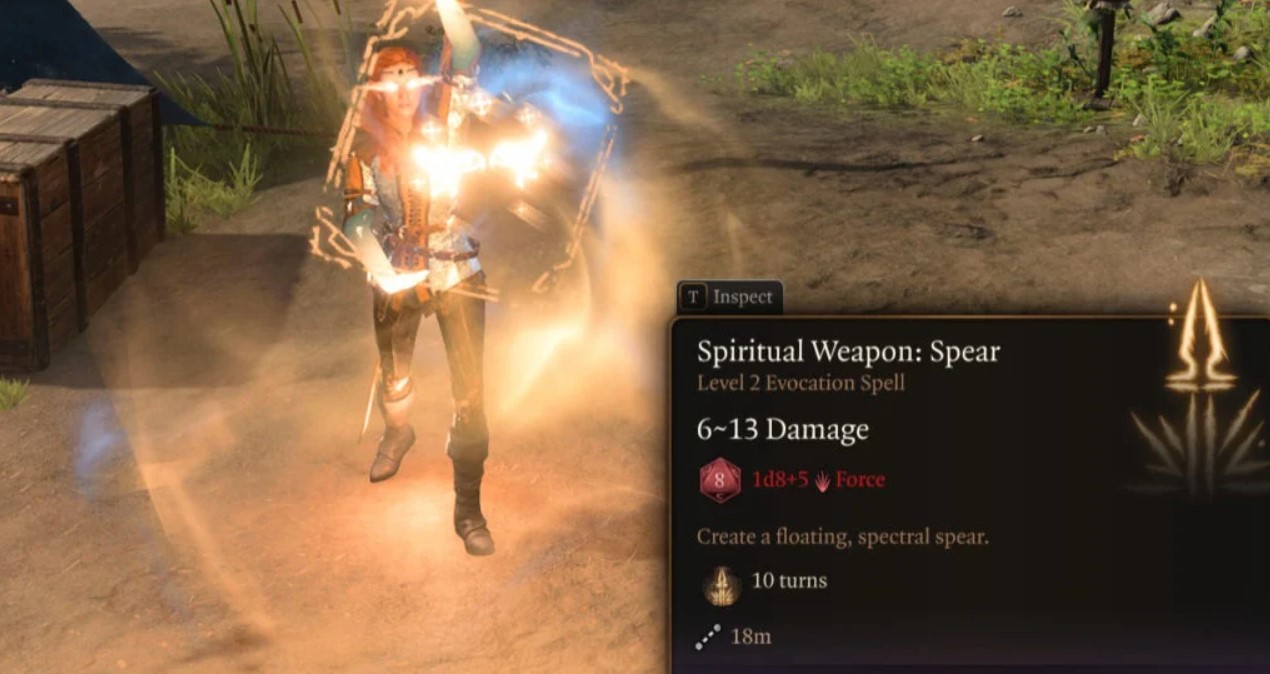
The base damage is 1d8 plus your spellcasting modifier. For a Cleric, that means Wisdom. If your Wisdom is high, the weapon hits harder and more consistently.
But there’s a catch. The movement speed is painfully slow. It only moves 20 feet, or 6 meters, per turn. If you summon it too far from the action, it will just float there uselessly while the battle moves away. Always summon it directly next to the biggest threat.
Here’s how it works when you cast it at higher levels. The spell scales beautifully. Every two levels above level two adds another 1d8 Force damage.
| Spell Slot Level | Damage Output | Additional Benefits |
| Level 2 | 1d8 + Modifier | Base spell, great for early game aggro. |
| Level 4 | 2d8 + Modifier | Solid mid-game damage boost. |
| Level 6 | 3d8 + Modifier | Heavy hitter for boss fights. |
You do not want to cast it at level three or five, because it will not gain extra damage. Always upcast on even numbers.
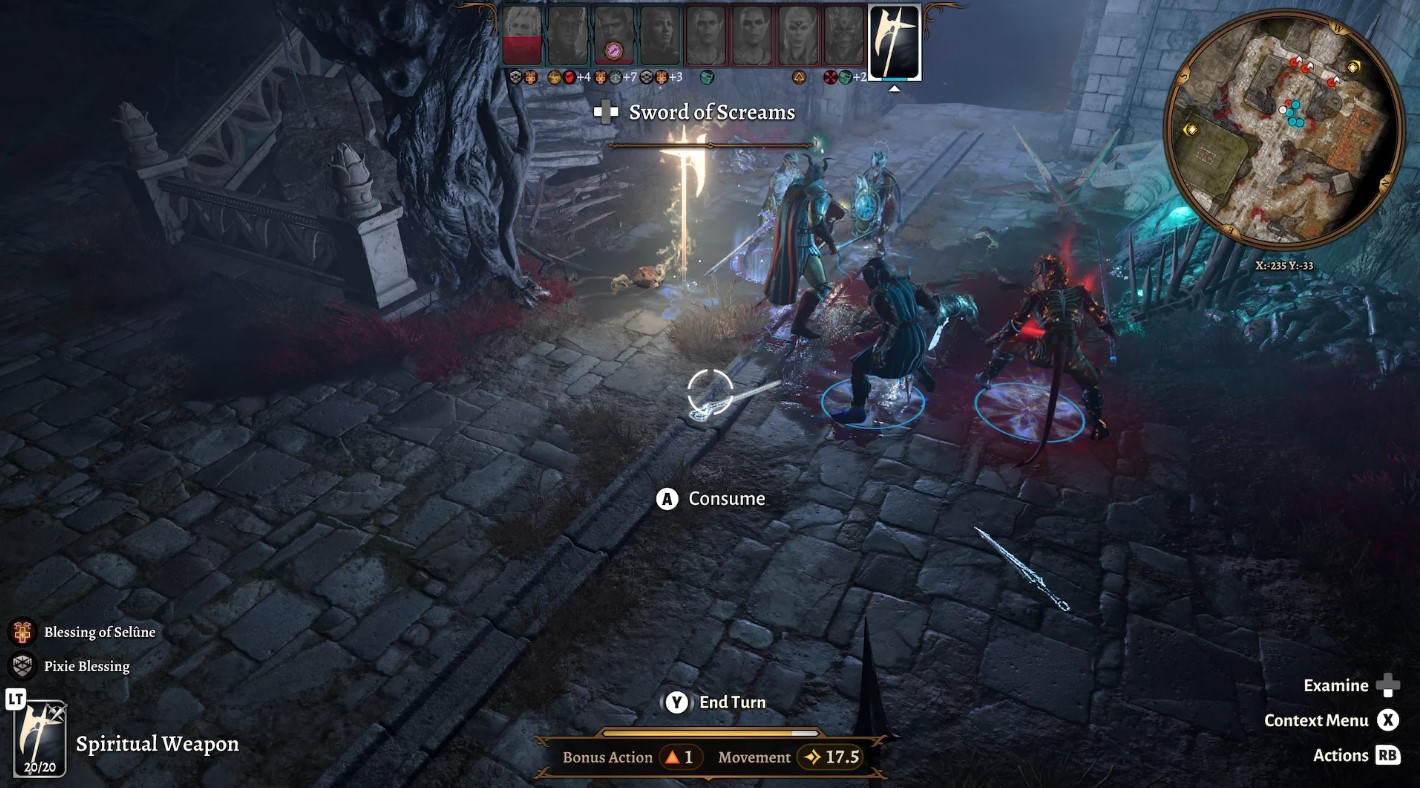
Best Classes for the Spiritual Weapon in Baldur’s Gate 3
Not everyone can summon this glowing lifesaver. You have to pick the right class or subclass.
Clerics get it automatically. Shadowheart will likely be your primary caster for this. But other classes can grab it too.
- Clerics (All Domains): It is a staple of the class. Life, Light, Tempest, or Trickery – every Cleric wants this prepared.
- College of Lore Bards: At level six, Lore Bards get Magical Secrets. You can snatch this spell from the Cleric list. It fits perfectly with a Bard’s support playstyle.
- Oath of Devotion Paladins: They get it automatically at level five. Paladins normally rely on Divine Smite, but having a floating sword fighting beside you adds great utility.
Let me explain the weapon forms. When you cast it, you do not just get a generic sword. You get to pick what shape it takes. Each shape comes with a unique special attack.
| Weapon Form | Special Attack | Best Situation to Cast |
| Halberd | Lacerate (Bleeding) | When you need to drain enemy health over time. |
| Maul | Tenacity (Guaranteed damage) | Fighting enemies with massive Armor Class. |
| Trident | Piercing Strike (Gaping wound) | Setting up rogues for extra damage. |
| Sword | Pommel Strike (Daze) | Stopping enemies from taking reactions. |
I found that the Maul is usually the most reliable. Even if it misses, Tenacity ensures it still deals a few points of bludgeoning damage. Every little bit counts.
Check this out. The community on Reddit figured out some brilliant ways to maximize this spell. It is not just about dealing damage. It is about controlling the battlefield.
- Body Blocking: Enemies cannot walk through the weapon. Summon it in a narrow doorway. Ranged attackers can shoot over it, while melee enemies get stuck trying to bash it.
- Absorbing Opportunity Attacks: Move the weapon past an enemy. The enemy will often waste their reaction swinging at the floating hammer. Then, your fragile characters can run away safely.
- Triggering Sneak Attacks: Rogues need an ally next to their target to get Sneak Attack damage. The spiritual weapon in Baldur’s Gate 3 counts as an ally. Drop it next to a boss, and let Astarion go to work.
This could work for you if you struggle with positioning. Treat the summon like a disposable tank. It has its own health pool. When enemies attack it, they are wasting turns.
However, there are mistakes you need to avoid.
- Summoning it too early before the enemy closes the gap.
- Forgetting it cannot jump or climb ladders.
- Casting it on a level three slot, expecting a damage bump.
The lack of vertical mobility is a massive pain. If you fight on a roof, and the goblin climbs down a ladder, your weapon is stuck up there. You cannot command it to jump.
And that’s why it matters where you place it on turn one. Put it exactly where the main brawl is happening.
Advanced Tactics and Battlefield Control
Let’s look at how this spell changes boss fights. In Act 1, you fight a certain Hag. She creates duplicates of herself. Any damage makes a duplicate disappear. A floating weapon that deals guaranteed damage on a miss (like the Maul) is perfect for popping those illusions.
Or consider the Goblin Camp. It is chaotic. There are enemies everywhere. You can drop the weapon near the archers up in the rafters. It distracts them from shooting your frontline fighters.
It is a simple strategy. You overwhelm the AI. The game’s artificial intelligence often targets the closest enemy with low AC. The weapon has decent health but terrible AC. Enemies flock to it like moths to a flame.
Just remember to manage your bonus actions. If you need to drink a potion, you cannot summon it that same turn. Plan your first round of combat carefully.
FAQ
Does the spiritual weapon in Baldur’s Gate 3 require concentration?
No. You can keep your concentration on other important spells like Bless or Spirit Guardians while it stays active.
Can it make opportunity attacks?
Yes. If an enemy tries to walk away from it, the weapon will take a swing at them.
Can you heal the weapon?
Technically yes, but you really should not waste spell slots healing a temporary summon.
Does the damage type change based on the form?
Yes and no. It always deals base Force damage, but special attacks might add slashing or bludgeoning effects depending on the shape you pick.
How long does it last?
It lasts for 10 turns, which equates to one full minute in game time. This is more than enough for almost any combat encounter.
Why can’t my weapon reach the enemy?
It only has a movement speed of 20ft (6m) and it cannot jump or climb. Always summon it right next to your target.
Does it get extra attacks at higher levels?
No. Upcasting it only increases the damage dice, not the number of attacks it can make per turn.
Wrapping Up Your Strategy
Fighting in Faerûn is tough. You need every advantage you can get. The spiritual weapon in Baldur’s Gate 3 provides incredible value for a level two spell slot. It gives you an extra fighter, deals rare Force damage, and distracts the enemy AI perfectly.
Keep an eye on its terrible movement speed, and always pick the right form for the right enemy. Follow these straightforward steps, and your Cleric will carry the team through the hardest encounters.
If you found this useful, do us a huge favor by bookmarking the page and sharing this post across your social media channels. You know what, we are always open to exciting new ventures, so feel free to drop the Lizet Manski team a direct message if you are looking for a creative or commercial collaboration. Every share helps us grow, and we honestly cannot wait to see what awesome projects we might build together next.