
Summer Crops in Stardew Valley That’ll Fill Your Wallet
Summer in Pelican Town hits different. The sun’s blazing, your sprinklers are finally earning their keep, and the soil is practically begging you to get rich. If spring was about finding your feet, summer is when the real money starts rolling in. And there’s a lot of money to be made. Trust me. Here’s the thing though – summer has the widest variety of profitable crops in the whole game, which is fantastic but also a little overwhelming. Blueberries? Starfruit? Hops? Melons? Which do you actually plant? Pick wrong and you’ll leave thousands of gold on the table. Pick right and you’ll be swimming in it by fall.
So let’s break down the best summer crops in Stardew Valley – what to grow, when, and how to process it all for maximum profit. Whether you’re a fresh-faced Year 1 farmer or a seasoned keg-hoarding tycoon, there’s a strategy here for you. Let’s get planting.
What Makes Summer the Golden Season?
Before we get to specific crops, let’s talk about why summer is such a big deal for your farm’s finances. Because understanding this shapes every planting decision you make.
Summer is widely considered Stardew Valley’s golden season for making serious money. The crops grow fast, the season is long, and you’ve usually got enough infrastructure by now – sprinklers, maybe a few kegs – to really capitalize. It’s the season where a smart farmer can go from scraping by to genuinely wealthy.
With the addition of Summer Squash in the 1.6 update, there are now fifteen summer-exclusive crops to consider. Here’s the full lineup:
- Blueberry, Corn, Hops, Melon, Poppy, Radish, Starfruit, Sunflower, Tomato, and Wheat.
- Hot Pepper, Coffee Bean, Red Cabbage, Summer Spangle, and Summer Squash.
That’s a lot of choice. But here’s a critical lesson that trips up newcomers: raw sell price alone is misleading. A crop’s base value tells you almost nothing about its actual profitability. What really matters is gold per day – how much you earn per tile per day, factoring in growth time, regrowth, and multiple harvests. Once you think in those terms, the rankings flip entirely. Let me show you what I mean.
The Best Summer Crops in Stardew Valley for Beginners
If you’re in your first year or just want reliable, low-stress income, this section is for you. These are the crops the community recommends when you don’t have a huge keg operation running yet.
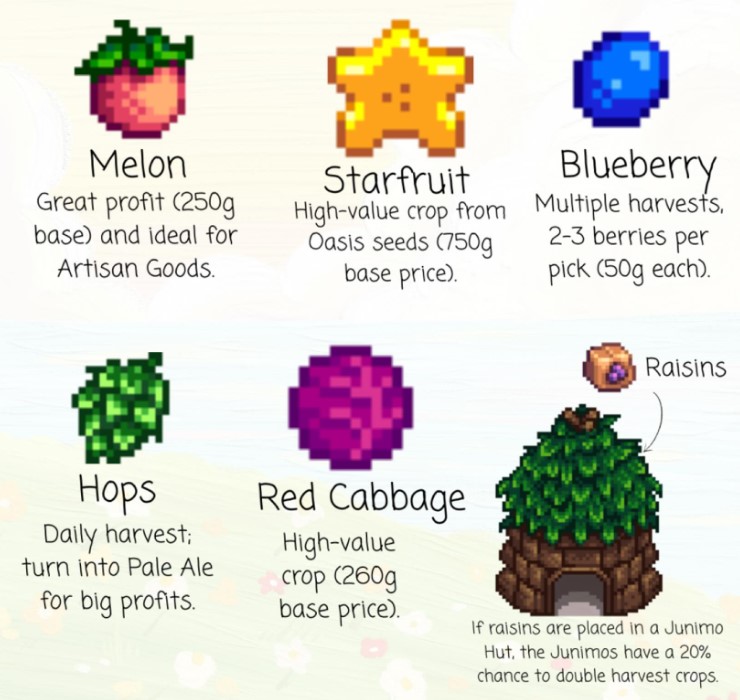
Blueberries are the undisputed beginner champion, and honestly the most profitable summer crop for most players. Here’s why they’re so beloved. You buy the seeds affordably from Pierre, they take 13 days to mature, and then – this is the magic – they regrow every four days, producing three berries per harvest. That’s a metric ton of berries spamming out across the season from a single planting. The community adores them precisely because they offer safe, low-maintenance, high-volume profit. Plant a big blueberry field in Year 1 and you literally cannot go wrong.
Melons are the other staple beginner pick. They’re the second most valuable crop you can plant if you haven’t unlocked Starfruit yet, and here’s a bonus – you need melons for both the Summer Crops Bundle and five gold-star melons for the Quality Crops Bundle in the Community Center. So you’ll want to grow them anyway. Decently profitable, useful for bundles, and they make solid wine. A win all around.
Hot Peppers deserve a shout for beginners too. They mature quickly and keep producing every few days, making them a dependable trickle of incremental profit throughout the season. They’re not flashy, but they fill gaps nicely and keep your fields productive.
| Crop | Growth Time | Regrows? | Why Plant It |
|---|---|---|---|
| Blueberry | 13 days | Every 4 days | Best raw profit, high volume |
| Melon | 12 days | No | Bundle needs, good wine |
| Hot Pepper | 5 days | Every 3 days | Steady incremental income |
| Corn | 14 days | Every 4 days | Carries into fall, versatile |
| Tomato | 11 days | Every 4 days | Reliable regrowing staple |
Notice that several of these regrow. That’s the key to beginner profit – a crop you plant once and harvest repeatedly saves you seed costs and effort. Blueberries, corn, tomatoes, and hot peppers all do this, which is why they punch above their modest sell prices.
Starfruit: The Flashy High-Roller
Now let’s talk about the crop everyone obsesses over. Starfruit. It’s the flashiest, highest-value standard crop in the season, and for good reason.
Starfruit tops the raw price list at 750g base, dwarfing everything else. But here’s where it gets wild – you’re not supposed to sell it raw. Every single Starfruit should go through a keg to become Starfruit Wine, which sells for 2,250g base and a staggering 3,150g with the Artisan profession. Some sources put aged wine even higher. This single crop defines your summer profit ceiling. Nothing else comes close when processed.
There’s a catch, though, and it’s a big one. Starfruit seeds are only available at the Oasis in the Calico Desert, which requires completing the Vault bundles to unlock the desert bus. That means access to a considerable amount of gold – roughly 42,000g for the bus repair – plus 500g per ticket. So realistically, you won’t be growing Starfruit in your first summer unless you really know what you’re doing.
That’s why the community consensus is clear: plant Blueberries in Year 1, and bring in Starfruit from Year 2 onward once you’ve got the Oasis unlocked and a bank of kegs ready. Don’t stress about Starfruit early. Build up to it. When you’re ready, it becomes the backbone of a serious money machine.
Hops and the Pale Ale Money Machine
Here’s a crop the community says everyone sleeps on, and it’s a genuine mistake to ignore it. Hops.
On paper, Hops look weak. A single hop sells for just 25g. Blink and you’d dismiss it. But that raw number hides one of the best keg-throughput plays in the entire game. Here’s the deal: Hops cost 60g per seed at Pierre’s, grow in 11 days on a trellis, and then harvest every single day after that. In a 28-day summer, that’s around 17 harvests per plant. The daily yield is relentless.
And when you funnel all those hops into kegs to make Pale Ale? That’s where the magic happens. Pale Ale sells for around 300g base per keg cycle, or 420g with Artisan. One community member calculated that a single hops plant paired with a keg can generate roughly 2,400g over two weeks. Tile for tile, many veterans argue Hops is the most profitable crop you can plant, provided you’re brewing it all into Pale Ale.
But – and this is crucial – Hops demands work. That daily harvesting gets genuinely exhausting, and you need a dense network of kegs to process the constant flood of hops. As one forum regular put it, the every-day harvest gets to be hard work in normal runs. So Hops is a play for dedicated, infrastructure-heavy farmers, not casual players.
A popular expert strategy is “Hops infilled with Starfruit” – fill your field with Hops for daily Pale Ale income, and tuck Starfruit into any spare tiles for premium wine. That combo is often cited as the most profitable summer setup possible. Demanding, sure, but ridiculously lucrative.
Processing Is Where the Real Gold Lives
Let me hammer home the single most important lesson about summer crops in Stardew Valley: raw selling is for chumps. Processing is where fortunes are made. Seriously, this is the difference between a modest farm and a gold-printing empire.
The two main processing routes are Kegs (for wine, juice, and ale) and Preserves Jars (for jam and pickles). Here’s how the community prioritizes them for summer:
- Starfruit → Keg → Wine is the top priority; it’s your highest per-unit value by a mile.
- Hops → Keg → Pale Ale is the second priority if you’re running a dense keg setup and can handle daily harvests.
- Melon → Keg → Wine at 825g base is respectable; use spare keg capacity after the above.
- Blueberry → Jar → Jam is often better than wine per fruit, so send blueberries to jars when available.
That blueberry tip is worth emphasizing. Blueberries produce so many berries that turning them into jam or preserves multiplies your profit dramatically. And here’s a clever community trick – you can also run blueberries through Seed Makers. You’ll still average more money than selling raw, and there’s a small chance of getting an Ancient Seed, which you’ll want for your greenhouse anyway. Sneaky and smart.
One golden rule from the min-maxers: if you care about money, you’re going Artisan profession, full stop. Artisan boosts all your processed goods by 40%, turning good profits into great ones. Don’t sell your kegged and jarred goods until you’ve grabbed it.
Don’t Forget the Non-Money Crops
Quick tangent, because chasing pure profit isn’t the only reason to plant something. Some summer crops earn their place for other reasons, and ignoring them entirely is a rookie move.
Several crops are needed for bundles in the Community Center – melons, corn, and others show up here, and completing bundles unlocks huge rewards. Some crops feed into cooking recipes you’ll want for buffs and gifts. And flowers like Poppy, Sunflower, Summer Spangle, and the fast-growing Summer Squash have their own uses, from gifts to dye to the raccoon quests introduced in 1.6.
Summer Squash is a fun 1.6 addition worth noting. It grows in just six days, regrows every three, and its seeds can’t be bought at any store – you find them through digging, raccoon quests, and other special means. The low sell price is offset by that fast, repeatable growth. A neat little novelty crop.
So don’t tunnel-vision purely on gold. A balanced farm with some bundle crops, some cooking ingredients, and a few flowers keeps your whole game moving forward, not just your bank balance.
Putting It All Together: A Summer Game Plan
Alright, let me tie this into an actual strategy you can follow, because knowing the crops is one thing and planning your season is another.
If you’re a Year 1 farmer, keep it simple. Plant Blueberries as your main money crop – affordable, regrowing, low risk. Dedicate a row to Melons for the bundles and gift potential. Toss in some Corn since it carries into fall, saving you a replant. Sell raw or start dabbling with jars as you build them. Solid, stress-free, profitable.
If you’re a Year 2+ farmer with infrastructure, it’s time to level up. Unlock the Oasis and bring in Starfruit for premium wine, assigning each one a dedicated keg. If you’ve got kegs to spare and don’t mind the grind, start a Hops operation for daily Pale Ale. Keep some Blueberries running through jars, and always sell your artisan goods only after hitting the Artisan profession.
And if you’ve reached end-game with a greenhouse, the meta shifts toward Ancient Fruit, which fruits all summer and fall with no replanting. Many veterans quarter their greenhouse between strawberries, blueberries, cranberries, and Starfruit. But that’s a whole other guide.
The beauty of summer is its flexibility. There’s a profitable path whether you want minimal effort or maximum min-maxing. Just match your ambition to your infrastructure and you’ll thrive.
FAQ
What’s the most profitable summer crop in Stardew Valley?
Blueberries are best for raw profit and low effort. Starfruit wins overall once processed into wine, and Hops tops the charts tile-for-tile as Pale Ale.
Should I sell crops raw or process them?
Process them. Starfruit into wine, blueberries into jam, and hops into Pale Ale all multiply your profits far beyond raw selling, especially with Artisan.
When can I grow Starfruit?
Once you unlock the Calico Desert by completing the Vault bundles. Seeds are sold at the Oasis, so it’s usually a Year 2 crop for most players.
Are blueberries good for beginners?
Absolutely. They’re affordable, regrow every four days with three berries per harvest, and offer the best low-maintenance profit in your first summer.
Why are hops so valuable?
Hops harvest daily and, when brewed into Pale Ale in kegs, generate enormous profit per tile. The catch is the daily harvesting and heavy keg requirement.
What summer crops do I need for bundles?
Melons and corn are common bundle crops, and you’ll want five gold-star melons for the Quality Crops Bundle in the Community Center.
What’s new for summer crops in 1.6?
Summer Squash was added. It grows in six days, regrows every three, and its seeds are found through digging and raccoon quests rather than shops.
Wrapping It Up
So there’s your complete guide to summer crops in Stardew Valley. The season is a genuine goldmine, offering more profitable options than any other time of year. Whether you go for the reliable blueberry spam, the premium Starfruit wine play, or the demanding-but-lucrative Hops-and-Pale-Ale grind, there’s serious money waiting to be farmed.
My honest advice? Start with Blueberries and Melons in Year 1 to build a stable foundation, then graduate to Starfruit and Hops once you’ve got the Oasis unlocked and kegs humming. Always process your crops rather than selling raw, grab the Artisan profession, and don’t forget the bundle crops that unlock the Community Center’s rewards.
Summer only lasts 28 days, so plan your planting early and make every tile count. Get it right, and you’ll roll into fall with a bank account fat enough to fund whatever farm dreams come next. Now grab your hoe and get out there – those crops won’t plant themselves.
If this guide helped boost your harvest, please support us by sharing the post across your social media and adding it to your bookmarks so it’s easy to find later. Every share genuinely helps our team keep guides like this coming. And if you’re seeking creative or commercial collaboration, feel free to write to the Lizet Manski team directly – we’d love to hear from you.